

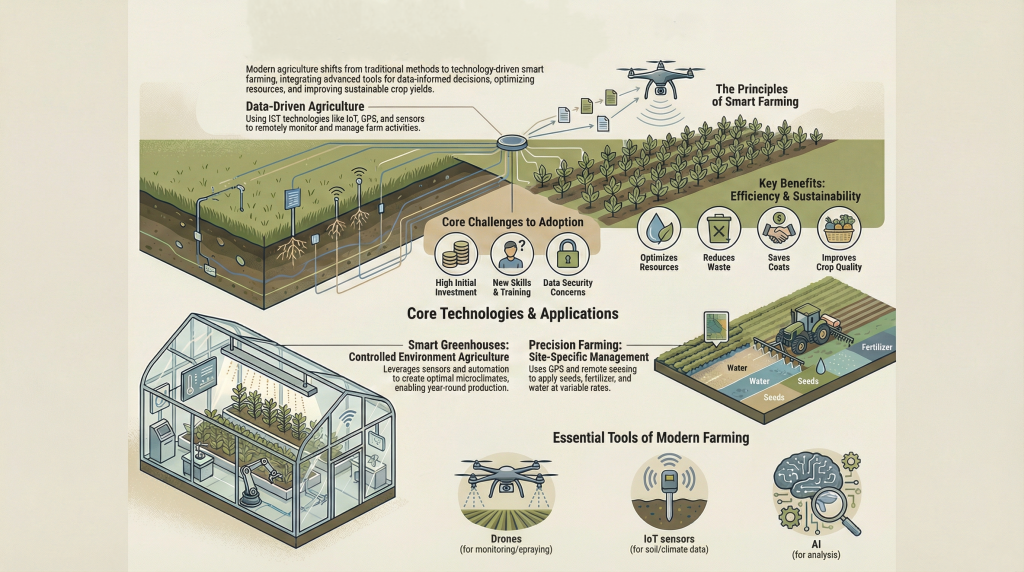
This comprehensive 6,000+ word analysis examines breakthrough research in smart farming
technologies published in the International Journal of Research in Agronomy. As global population
approaches 10 billion and climate change intensifies, smart farming emerges not as mere
innovation but as essential infrastructure for human survival. This guide provides researchers with
critical insights into interdisciplinary research opportunities while equipping importers, exporters,
and agricultural businesses with strategic intelligence for market entry and profitable growth in this
rapidly expanding sector.
Compelling Market Statistics
- Global smart agriculture market projected to reach $34 billion by 2026, growing at 12%
annually - Smart farming increases yields by 10-30% while reducing water usage by 30-50%
- Fertilizer savings of 20-40% and pesticide reductions up to 90% achievable
- Return on investment typically occurs within 2-5 years
- Labor efficiency improvements of 20-40% through automation
Why This Matters NOW More Than Ever
Imagine walking through farms where sensors monitor every plant in real-time, drones survey
thousands of acres in minutes, and artificial intelligence predicts optimal harvest timing. This is not
science fiction – it is happening now in agricultural fields worldwide. As population surges toward
10 billion by 2050 and climate change threatens traditional farming methods, smart farming
technology is not just innovative but absolutely essential for our collective survival.
Whether you are a researcher seeking to understand the latest agricultural innovations, an
importer or exporter looking to identify lucrative opportunities in agri-tech, or a farmer considering
technology adoption, this comprehensive guide breaks down groundbreaking research revealing
how smart farming is revolutionizing agriculture across the globe.
The Evolution of Agriculture: From Manual Labor to AI-Powered Farms
Agriculture has undergone four major transformations that fundamentally changed how humanity
produces food. Understanding this evolution is crucial for appreciating why smart farming
represents not just an improvement but a complete paradigm shift in agricultural practices.
Agriculture 1.0 (Ancient to 1800s): Manual labor dominated with basic tools like shovels and
sickles. Farmers relied on physical labor and animal power for all operations. Production was
limited by human and animal capacity.
Agriculture 2.0 (19th Century): Steam engines and mechanization emerged. Tractors replaced
animal power. Chemical fertilizers increased productivity. Farms grew larger and more productive.
Agriculture 3.0 (20th Century): Programmed machinery and early robotics appeared. Automation
reduced manual labor. Precision equipment improved efficiency.
Agriculture 4.0 (Present): AI-powered, data-driven connected systems. IoT sensors, drones,
autonomous equipment, and advanced analytics transform operations. Real-time decision making
based on comprehensive data analysis.
The transition from Agriculture 3.0 to 4.0 represents the most significant leap in farming history.
Traditional methods face critical limitations: labor shortages as rural populations migrate to cities,
climate change introducing unprecedented weather variability, and exponential population growth
demanding more food from the same or even less arable land. Agriculture 4.0 addresses these
fundamental challenges through technology integration.
What is Smart Farming? Understanding the Definition
According to research, smart farming is precision agriculture advanced by modernization and
clever data collection methods that enable remote management supported by real-time
maintenance alternatives. In practical terms, smart farming integrates cutting-edge Information and
Communication Technologies to transform traditional agricultural operations into data-driven,
automated systems.
Core Technologies in Smart Farming
- Internet of Things (IoT) sensors for continuous monitoring
- Global Positioning Systems (GPS) for precise location tracking
- Drones and unmanned aerial vehicles for aerial surveillance
- Robotics and autonomous equipment for automated operations
- Artificial Intelligence for pattern recognition and prediction
- Data analytics platforms for actionable insights
- Precision equipment for targeted input application
Transformative Benefits of Smart Farming
Research identifies four core benefit categories driving rapid global adoption of smart farming
technologies. Understanding these benefits is crucial for technology developers and agricultural
stakeholders.
Sustainability and Resource Conservation: Smart farming dramatically minimizes resource use.
Precision technologies ensure water, fertilizers, and pesticides are applied only where needed in
exact amounts required. Studies document water savings of 30-50%, fertilizer reductions of
20-40%, and pesticide use cuts up to 90%.
Significant Cost Savings: Optimizing inputs and reducing waste generates substantial cost
savings. Precision application eliminates over-application of expensive inputs. Automated systems
reduce labor costs. Predictive analytics prevent crop losses. Many farmers report 15-25%
reduction in overall production costs.
Data-Driven Decision Making: Perhaps most transformative is access to real-time data and
actionable insights. Farmers shift from intuition-based to evidence-based strategies. Historical data
reveals patterns enabling continuous improvement. This transforms farming from reactive to
proactive management.
Seven Critical Smart Farming Technologies Explained
- Remote Sensing – Eyes in the Sky
Remote sensing uses satellites and aircraft to detect and monitor agricultural land by measuring
reflected and emitted radiation. This enables farmers to map soil properties, assess crop
conditions, determine land suitability, and manage irrigation with unprecedented precision without
physically inspecting every field. Applications include vegetation health mapping, soil moisture
assessment, early disease detection, yield prediction, and drainage analysis. - GPS and GIS – Navigation Revolution
Geographic Information Systems integrate and visualize geospatial data while GPS provides
three-dimensional positioning accurate to centimeters. GPS-guided tractors reduce field operation
overlap by up to 95%, saving fuel, seeds, and fertilizer. Variable rate technologies use GIS data to
apply inputs precisely where needed, reducing waste and environmental impact significantly. - Agricultural Drones – Aerial Platform Revolution
Drones weighing 2-20 kilograms equipped with multispectral cameras capture detailed crop health
imagery invisible to human eyes. They perform soil analysis, planting (shooting seed pods
reducing costs 85%), crop spraying (90% reduction in chemical use), vegetation index mapping,
thermal imaging for irrigation management, and detailed field analysis. This technology
democratizes precision agriculture for farms of all sizes. - Autonomous Tractors – Driverless Operations
These autonomous vehicles operate without human drivers using GPS-based auto-steer, vision
systems, and advanced sensors achieving centimeter-level accuracy. Economic impact is
substantial: 24/7 operation dramatically increases productivity while reducing labor costs.
Continuous sensor data collection optimizes operations through ongoing learning and adjustment. - IoT Sensors – Farm Nervous System
IoT creates networks where devices exchange data for specific purposes. In agriculture, sensors
monitor soil nutrients, air temperature, humidity, CO2 levels, lighting, and pest infections. Real-time
data enables precise decisions about planting, irrigation, fertilization, and pest management.
Research indicates IoT could account for 3% global carbon reduction by increasing efficiency. - Artificial Intelligence – The Brain
AI systems perform tasks requiring human intelligence: learning from experience, recognizing
patterns, and problem-solving. Applications include crop yield prediction with 90%+ accuracy,
disease and pest identification through image recognition, optimal harvest timing, weather pattern
analysis, automated produce sorting, and market price forecasting. AI improves both efficiency and
output quality while ensuring faster time to market. - Data Analytics Platforms – Insight Generation
Advanced analytics process vast data volumes from multiple sources to generate actionable
recommendations. Machine learning algorithms identify patterns humans cannot detect. Predictive
models forecast outcomes of different management strategies. Integration platforms combine data
from sensors, satellites, weather stations, and market systems into unified dashboards guiding
farmer decisions.
Smart Greenhouses: The Future of Controlled
Environment Agriculture
Climate change disrupts traditional agriculture worldwide. Smart greenhouses and Controlled
Environment Agriculture (CEA) emerge as key solutions, optimizing crop production by
manipulating indoor climate while mitigating climate change effects. CEA includes greenhouses,
rooftop installations, growth chambers, plant factories, and vertical farms.
Critical Components of Smart Greenhouses
- Temperature, humidity, light, soil moisture, and CO2 sensors for continuous monitoring
- Automated actuators controlling ventilation, irrigation, and shading
- Data analytics systems identifying patterns and generating recommendations
- Renewable energy integration (solar panels, wind turbines, battery storage)
- IoT connectivity enabling remote monitoring and control
- User-friendly dashboards and mobile applications
- Security systems including CCTV and smart locks
- Data encryption and privacy protection measures
Key Advantages
Real-time environmental monitoring with automated adjustments maintains optimal growing
conditions. Precision soil management tracks moisture and salinity. Machine learning determines
chemical application timing and amounts, preventing overuse and producing safer food.
Year-round production maximizes facility utilization. Yields often reach 2-3x conventional
production. Enhanced security protects valuable crops and infrastructure.
Precision Farming: The Pinnacle of Agricultural Innovation
Precision Agriculture enhances yields through advanced sensors and analysis technologies
supporting management decisions. This approach promises increased output, reduced labor costs,
and efficient resource management. It utilizes extensive data to enhance crop quality, yields, and
resource utilization. Technologies include data collection (GPS, remote sensing, soil sampling),
data processing and decision-making (GIS, sensor networks, analytics), and application
technologies (variable rate systems, GPS-guided equipment).
Variable Rate Application (VRA)
VRA is a key precision farming component enabling farmers to apply inputs at variable rates
across fields based on spatial variability in soil properties and crop requirements. Rather than
uniform application, VRA tailors rates to specific zone needs. This optimizes resource efficiency,
minimizes waste, and maximizes yields. Farmers report 20-30% fertilizer cost reduction while
increasing yields 10-20%. Environmental benefits include reduced nutrient runoff and pesticide
residues
Site-Specific Crop Management (SSCM)
SSCM manages crop variability between and within fields through monitoring, measuring, and
responding to differences. Modern methods use precise GPS with site-specific measurements
quantifying spatial field variations. Data sources include field observations and remote sensing.
Tools like EOSDA Crop Monitoring identify problem areas with potential pathogens: pests, fungi,
fertilizer issues, weeds, or moisture deficiency.
Quantified Benefits
- Minimizing costs of water, seeds, fuel, and other materials
- Maintaining soil health through reduced pesticide applications
- Lowering weather dependence via predictive analytics
- Maximizing genetic potential through optimized conditions
- Reducing environmental impact through targeted application
- Enhancing profitability via cost reduction and yield improvement
- Enabling better decision-making through data insights
Nutrient-Sensitive Agriculture: Growing Nutritious Food
Nutrition-sensitive agriculture represents a paradigm shift from maximizing yields to prioritizing
nutritional outcomes. This food-based approach places nutritionally rich foods, dietary diversity,
and food fortification at the heart of overcoming malnutrition and micronutrient deficiencies. The
objective is making the global food system better equipped to produce good nutritional outcomes
while educating families about producing, purchasing, preparing, and consuming healthy foods.
Eight Key Strategies
Soil Fertility Enhancement: Managing nutrient cycling through organic matter, microorganisms,
minerals, and cation exchange. Efficient recycling through soil food web maintains fertility. Key
cycles include carbon, nitrogen, and phosphorus.
Strategic Crop Rotations: Increases soil biodiversity and nutrient cycling by supplying different
residue types. Reduces disease and pest buildup. Different rooting patterns extract nutrients from
all soil layers efficiently.
Soil and Water Conservation: Erosion removes nutrient-rich topsoil. Conservation measures
minimize losses and sustain productivity. Drainage improvements reduce runoff, erosion, and
compaction while promoting healthy root growth.
Compost and Amendments: Composting conserves volatile nutrients by incorporating them into
stable organic forms. Inorganic byproducts like wood ash, rock dust, and gypsum can also supply
plant nutrients. Maintaining proper soil pH prevents mineral unavailability.
Precision Fertilizer Application: Variable rate application based on soil tests and crop needs
ensures nutrients are available when and where plants need them, minimizing waste and
environmental impact while maximizing efficiency.
Mixed Crop-Livestock Systems: Approximately 75% of NPK in animal feed is excreted in manure
or urine, enabling large-scale nutrient recycling. Integration creates closed-loop systems reducing
external input needs.
Comprehensive Soil Testing: Analyzing samples determines nutrient levels, pH, and organic
matter content. Regular testing tracks changes over time, enables practice adjustment, and
prevents imbalances reducing yields or quality.
Bio-fortification: Developing nutritionally enhanced crops with higher bioavailability through
breeding and transgenic approaches. Examples include golden rice, anthocyanin-rich vegetables,
and high-zinc high-iron varieties.
Understanding Implementation Challenges
While benefits are compelling, research honestly addresses significant barriers. Acknowledging
these challenges is essential for researchers developing solutions and businesses planning market
strategies.
High Initial Investment: Sensors, drones, IoT devices, and automated equipment require
substantial upfront capital. Small farmers often lack financial resources. Beyond purchase costs,
ongoing maintenance expenses must be considered. This creates barriers particularly in
developing markets.
Technical Knowledge Requirements: Farmers need training in technology use, data collection,
analysis, and interpretation. This learning curve is time-consuming and may require time away
from daily operations. The digital divide between early adopters and traditional farmers continues
widening.
Infrastructure Limitations: Many agricultural areas lack reliable high-speed internet essential for
IoT systems. Power supply may be inconsistent or unavailable. Infrastructure upgrades require
significant investment beyond technology itself. This is particularly challenging in remote regions.
Data Management Complexity: Smart farming generates enormous data volumes. Farmers need
sophisticated tools and analytical skills to manage and interpret information effectively. Many feel
overwhelmed by complexity and struggle translating insights into action.
Data Security and Privacy: Technology use raises critical questions about data security. Farmers
must protect data from unauthorized access and comply with privacy regulations. Concerns about
data ownership and potential misuse by technology companies create adoption hesitation.
Critical Benefits for Researchers and Academia
This research opens numerous avenues for academic inquiry and practical application
development. Understanding these opportunities is essential for researchers seeking funding,
publications, and real-world impact.
Interdisciplinary Research: Smart farming sits at the intersection of computer science,
agricultural science, environmental science, economics, and engineering. Researchers can
leverage this nature to secure diverse funding and collaborate across departments. Focus areas
include AI and machine learning for prediction, IoT and sensor development, data science
analytics methods, robotics advancement, environmental impact studies, economic analysis, and
social science understanding of adoption patterns.
Technology Development and Patents: The sector offers substantial intellectual property
opportunities. Researchers can develop novel sensors, algorithms, equipment designs, or
integrated systems addressing current limitations. Universities can license technologies to
agricultural companies or spin off startups. Key innovation areas include low-cost sensors for
developing markets, improved AI algorithms, user-friendly interfaces, and integrated platforms.
Field Trial and Validation: Many technologies lack comprehensive field validation across diverse
conditions. Researchers can conduct long-term trials examining performance across different
crops, climates, soil types, and farm scales. Multi-year, multi-location studies generate high-impact
publications while building relationships with companies and farmers.
Climate Change Adaptation: Smart farming offers powerful tools for climate adaptation.
Research investigating how technologies help farmers adapt to changing precipitation,
temperature extremes, and pest pressure attracts significant funding. Areas include predictive
models, early warning systems, irrigation optimization, identifying climate-resilient varieties, and
carbon sequestration assessment.
Sustainability Assessment: Comprehensive lifecycle assessments are needed. Researchers can
quantify actual resource savings, carbon footprint reduction, water quality improvements, and
biodiversity impacts. This research supports policy development and investment decisions.
Economic Impact Studies: Understanding economic barriers and quantifying ROI is crucial for
diffusion. Researchers can analyze cost structures, financing models, adoption patterns, and
impacts at farm, regional, and national levels. This informs policy makers and helps companies
develop appropriate business models.
Education Program Development: The knowledge gap is a significant barrier. Researchers can
develop and evaluate educational programs, training materials, and extension services. This
applied research has immediate practical impact while generating publications on education
effectiveness.
Small Farm Applications: Most research focuses on large commercial operations. Tremendous
opportunities exist developing affordable, appropriate technologies for small farms and developing
regions. This addresses critical global food security while accessing international development
funding. Focus areas include low-cost sensors, mobile phone-based systems, community
equipment sharing, and integration with traditional knowledge.
Golden Opportunities for Importers, Exporters, and Businesses
The smart farming revolution creates unprecedented business opportunities across the agricultural
value chain. Positioned correctly, importers and exporters can build highly profitable businesses
while contributing to global food security.
Technology Equipment Import/Distribution: Growing demand for sensors, drones, GPS
equipment, automated irrigation, smart greenhouse components, and autonomous equipment.
Market strategy: Focus on regions experiencing rapid modernization. Establish manufacturer
partnerships in technology-advanced countries for export to emerging markets. Offer complete
systems with installation, training, and support. Equipment margins typically range 30-50% with
recurring revenue from maintenance, software subscriptions, and consumables. Global market
projected $34 billion by 2026.
Smart Greenhouse Construction: Rapidly growing segment includes structural materials, climate
control systems, automated irrigation, lighting systems, monitoring sensors, and control systems.
Target regions with extreme climates or water scarcity. Focus on high-value crops where
economics are favorable. Offer turnkey solutions including design, construction, technology
integration, and training. Market expected to reach $3.6 billion by 2028.
Precision Agriculture Services: Service-based businesses offer drone surveying, soil testing and
analysis, crop monitoring subscriptions, data analytics, and variable rate application without
equipment purchase. Business model: Charge per-acre fees or subscriptions. Minimal inventory
reduces capital needs. Partner with manufacturers for referral fees. Scale rapidly by hiring trained
operators.
Agricultural Software Platforms: Highest-margin segment includes farm management platforms,
mobile apps, AI-powered decision support, weather forecasting, market price prediction, and
supply chain management. Software can be localized for different regions with relatively low
additional investment. Subscription-based revenue provides predictable income. Focus on solving
specific pain points: pest identification, irrigation scheduling, harvest timing, or market access.
Bio-Fortified Seeds Distribution: Importing and distributing high-zinc rice, iron-enriched beans,
vitamin A-enhanced sweet potatoes, anthocyanin-rich vegetables presents significant
opportunities. Growing consumer nutrition awareness creates demand. Governments actively
promote bio-fortified crops combating malnutrition. Partner with international agricultural research
centers. Position as premium offerings commanding higher prices.
Organic and Sustainable Inputs: Smart farming reduces chemicals but requires alternatives.
Import and distribute biological pest control agents, organic fertilizers and amendments, microbial
soil inoculants, and cover crop seeds. These align with sustainable agriculture trends while
commanding premium prices.
Export of Smart-Farmed Produce: Products grown using smart farming command premium
prices internationally. Smart greenhouses enable year-round production. Precision farming
improves consistency and quality. Traceability provides transparency. Sustainability certifications
differentiate products. Focus on high-value items: fresh herbs, berries, exotic vegetables, edible
flowers. Target premium grocery chains and restaurant suppliers.
Training and Education Services: Technical knowledge gaps limit adoption. Offer training
programs, certification courses, educational workshops, and online learning platforms. Revenue
model: Per-participant fees for in-person training, subscription fees for online platforms, corporate
contracts for employee training. Partner with equipment vendors offering product-specific training.
Seek government contracts for farmer education.
Financial Services and Leasing: High costs limit adoption. Offer equipment leasing, pay-per-use
models, crop insurance tailored to precision farming, and financing programs. Address the
affordability barrier while building profitable businesses.
Integration and Installation Services: Farmers struggle integrating multiple technologies.
Provide system design and integration, installation and commissioning, customization for specific
crops and conditions, and ongoing technical support. Deep technical expertise creates barriers to
competition. Long-term service relationships generate recurring revenue. Position as
technology-agnostic integrator maximizing flexibility.
Strategic Market Entry Considerations
Successfully entering smart farming markets requires careful strategy. These considerations
significantly improve success rates and profitability.
Identify High-Potential Markets: Target regions with government support for modernization,
growing middle-class demand for quality, water scarcity driving irrigation adoption, labor shortages
making automation attractive, and export-oriented agriculture valuing consistency. High-potential
markets include Middle East and North Africa (climate challenges), Southeast Asia (technology
adoption), Latin America (export focus), and Sub-Saharan Africa (smallholder agriculture, mobile
penetration).
Build Strategic Partnerships: Success requires partnering with local distributors, agricultural
cooperatives, government extension services, financial institutions, and research institutions.
These relationships provide market knowledge, farmer access, credibility, financing solutions, and
technology validation.
Start with Demonstrations: Establish demonstration farms showcasing technology benefits.
Successful demonstrations generate word-of-mouth marketing, provide sales presentation data,
build relationships with early adopters, and identify necessary local adaptations.
Offer Comprehensive Solutions: Farmers need complete packages including equipment,
installation, training, ongoing support, financing options, and performance guarantees. Complete
solutions differentiate businesses and build stronger customer relationships than selling products
alone.
Adapt to Local Contexts: Technologies for large commercial operations may need modification
for smallholder farmers, different crops, or limited infrastructure. Invest in localization: simplified
interfaces, mobile-phone integration, solar power options, and scaled-down systems. Cultural
sensitivity and language localization are critical.
Economic Impact and Return on Investment Analysis
Understanding smart farming economics is crucial for farmers making adoption decisions and
businesses evaluating market opportunities. Research provides insights into costs, benefits, and
ROI timeframes.
Quantified Benefits of Adoption
Research and field studies document substantial benefits from technology adoption. These
benefits compound over time as farmers optimize technology use and gain experience with
data-driven decision making.
- Yield improvements of 10-30% through optimized conditions and timely interventions. Smart
greenhouses report 2-3x conventional yields. - Water savings of 30-50% through precision irrigation. Fertilizer savings of 20-40% through
variable rate application. Pesticide reductions of 30-90% through targeted application. - Labor efficiency gains of 20-40% through automation. One operator manages autonomous
equipment across multiple fields. Monitoring reduces field scouting time. - More consistent quality through optimized conditions. Reduced defects and waste.
Enhanced marketability enabling premium pricing. Better shelf life through optimal harvest
timing. - Early warning systems prevent crop losses. More consistent yields reduce income
variability. Better data supports insurance claims and risk assessment.
Example ROI Calculation: 500-Acre Corn Farm
This example demonstrates typical economics for a mid-sized commercial farm adopting core
precision agriculture technologies. Without smart farming: 180 bu/acre yield, total 90,000 bu,
revenue at $4.50/bu = $405,000, input costs $420/acre totaling $210,000, net income $195,000.
With smart farming: 207 bu/acre yield (+15%), total 103,500 bu, revenue $465,750, input costs
$350/acre (-17%) totaling $175,000, net income $290,750. Technology investment: $75,000. First
year net gain: $20,750. Annual ROI: 28%. Technology pays for itself in under 4 years while
generating $95,750 additional annual income. Benefits continue and often increase in subsequent
years as farmers optimize use.
Future Trends and Emerging Opportunities
Understanding emerging trends is crucial for researchers planning long-term projects and
businesses making strategic investments. These trends will shape smart farming’s next decade.
AI and Machine Learning Advancement: Next-generation systems will provide highly accurate
yield prediction, autonomous decision-making requiring minimal intervention, natural language
interfaces for conversational queries, and image recognition identifying hundreds of species with
99%+ accuracy.
5G Connectivity: 5G networks transform operations through ultra-low latency enabling real-time
equipment control, massive device connectivity supporting thousands of sensors, high bandwidth
enabling HD video streaming, and edge computing processing data locally for faster decisions.
Advanced Robotics: Agricultural robots will advance to autonomous fruit and vegetable
harvesters, weeding robots using computer vision, robotic pollinators supplementing natural
pollinators, and mobile platforms conducting multiple sequential tasks.
Blockchain for Transparency: Blockchain provides complete traceability from farm to consumer,
verifies sustainability claims and certifications, enables smart contracts automating payments, and
creates transparent immutable production records building consumer trust.
Gene Editing Integration: CRISPR and other technologies combined with precision agriculture
create crops with enhanced nutrition, improved disease and pest resistance, better drought and
heat tolerance, and optimized characteristics for specific conditions identified through data
analysis.
Vertical Farms Expansion: Smart farming enables economically viable vertical farms in urban
centers, providing fresh produce with minimal transportation, using 95% less water, producing
crops year-round, and reducing food miles to near zero.
Renewable Energy Integration: Smart farms increasingly integrate solar panels, wind turbines,
energy storage, and smart grids, creating energy-positive operations selling excess power. This
reduces operating costs while contributing to climate mitigation.
Digital Twins and Predictive Analytics: Digital twin technology creates virtual farm replicas.
Farmers test management strategies virtually before implementation, predict decision outcomes
with high accuracy, optimize operations continuously, and train AI systems without risking actual
crops.
Strategic Investment Recommendations
For businesses and investors considering smart farming opportunities, these recommendations
maximize success probability.
- Prioritize scalable solutions that work from small to large farms. Modular systems reduce
entry barriers while providing growth paths. - Emphasize ease of use. User-friendly interfaces and simplified operations are critical for
adoption. Invest in intuitive design and comprehensive training. - Build robust support systems. Technical support infrastructure is as important as
technology. Establish responsive teams, comprehensive documentation, and farmer
communities. - Pursue integration opportunities. Focus on platforms integrating multiple technologies rather
than standalone products. Farmers prefer comprehensive solutions. - Target high-value crops first. Economics are more favorable for expensive crops. Success
builds track records for expansion into commodity markets. - Leverage government programs. Many governments offer subsidies, grants, or low-interest
loans. Structure offerings to align with these programs. - Develop appropriate financing models. Offer leasing, pay-per-use, revenue-sharing, or
equipment-as-a-service models reducing initial investment barriers. - Invest in data security. As cyber threats increase, robust security becomes a competitive
differentiator. Prioritize encryption, secure storage, and transparent privacy policies.
Conclusion: Seizing the Smart Farming Opportunity
This comprehensive analysis of smart farming research reveals a sector undergoing revolutionary
transformation. Agriculture 4.0 technologies encompassing IoT sensors, drones, artificial
intelligence, autonomous equipment, and advanced analytics are fundamentally changing how
food is produced globally.
For researchers, smart farming opens vast opportunities spanning multiple disciplines. From
developing affordable sensors to creating better AI algorithms, from conducting field validation to
analyzing economic impacts, research possibilities are extensive and well-funded. The
interdisciplinary nature enables collaboration while addressing critical global challenges of food
security, climate adaptation, and environmental sustainability.
For importers, exporters, and agricultural businesses, smart farming represents one of the most
promising growth sectors of coming decades. The global smart agriculture market projects
double-digit annual growth for the foreseeable future. Opportunities exist across the value chain:
equipment distribution, greenhouse construction, precision services, software platforms,
bio-fortified seeds, organic inputs, premium produce export, training services, financial services,
and system integration.
Research identifies both substantial benefits and real challenges. Benefits include 10-30% yield
increases, 20-40% input cost reductions, improved quality, and enhanced sustainability.
Challenges include high costs, technical complexity, infrastructure requirements, and data
management needs. Successful businesses will address these through innovative financing,
comprehensive training, user-friendly design, and robust support.
Smart farming represents a fundamental transformation in food production. The convergence of
IoT, AI, robotics, and data analytics creates possibilities unimaginable a decade ago. Farms are
becoming data-driven businesses making evidence-based real-time decisions. This transformation
is essential: the world must produce significantly more food with fewer resources while adapting to
climate change.
The timing for involvement is ideal. Technology costs decline while capabilities improve. Farmers
increasingly recognize traditional methods cannot meet future challenges. Governments worldwide
support agricultural modernization. Consumer demand for sustainably produced food grows.
These converging trends create a perfect environment for smart farming adoption acceleration.
Whether you are a researcher seeking to contribute to agricultural innovation, a business
identifying market opportunities, or a farmer considering technology adoption, smart farming offers
compelling paths forward. The research reviewed provides a solid foundation for understanding the
technology, applications, benefits, challenges, and opportunities it creates.
The smart farming revolution is not coming – it is already here. The question is not whether to
participate, but how to position yourself most effectively in this rapidly evolving sector. With careful
strategy, appropriate partnerships, and commitment to addressing real agricultural challenges,
tremendous opportunities exist for creating successful, impactful ventures in smart farming.
Take Action Today
Now that you understand the smart farming landscape, opportunities, and strategies, it is time to
act. Whether researching, investing, or implementing, start small but start now. Technology
evolves rapidly – early movers gain significant advantages. Begin with demonstration projects, pilot
programs, or focused research studies. Build partnerships. Test technologies. Learn from
experience. The smart farming revolution offers opportunity for those willing to embrace innovation
and work toward a more sustainable, productive agricultural future.
Related Article: A Comprehensive Deep-Dive into the Global Revolution of Smart Farming
References & Technical Verification
1. About the Source Research
This analysis is grounded in the peer-reviewed research paper titled “A review on smart farming agriculture,” authored by a collaborative team from Sri Konda Laxman Telangana State Horticulture University, including K. Nirosha, B. Ashwin Kumar, B. Nithyasri, B. Rajashekar, Dr. B. Naveen Kumar, Dr. G. Vidya, Dr. G. Satish, Dr. P. Pravalika, Dr. R. Ravi Teja, and Dr. K. Sushma. Published in the International Journal of Research in Agronomy (2024), the study provides a high-level technical synthesis of the transition from traditional manual labor to Agriculture 4.0. The core technologies examined include the Internet of Things (IoT) for real-time monitoring, Kisan Drones for multispectral imaging, Automated Tractors, and Artificial Intelligence (AI) for predictive data analytics. Furthermore, the research explores the specialized fields of Smart Greenhouse Technology and Nutrient-Sensitive Agriculture, emphasizing the integration of Controlled Environment Agriculture (CEA) to mitigate climate-related yield volatility.
2. Why This Research Matters for Our Readers
• For Researchers: The paper establishes a critical technical taxonomy for the evolution of farming, categorizing milestones from the mechanized Agriculture 2.0 era to the current programmed and autonomous systems of Agriculture 3.0 and 4.0. It addresses significant research gaps regarding the application of multispectral data for vegetation index (VI) mapping and the deployment of Variable Rate Technology (VRT) to manage spatial field variability. Additionally, it highlights the pressing need for interdisciplinary solutions to current barriers, such as data security, infrastructure upgrades, and the high initial capital requirements for small-scale technology adoption.
• For Importers, Exporters, and Trade Professionals: This research provides evidence-based proof that smart farming leads to significant cost savings by optimizing the use of water, fertilizers, and pesticides. The findings indicate that the automation of sensors and machinery directly increases labor productivity, while technologies like driverless tractors enable 24/7 operations with centimeter-level precision. For those in the supply chain, the paper identifies Bio-fortification and Nutrient-Sensitive practices as key drivers for producing high-quality, marketable crops that meet the growing global demand for nutritionally enhanced food products.
3. Formal Citation for Authenticity Nirosha, K., Kumar, B. A., Nithyasri, B., Rajashekar, B., Kumar, B. N., Vidya, G., Satish, G., Pravalika, P., Teja, R. R., & Sushma, K. (2024). A review on smart farming agriculture. International Journal of Research in Agronomy, SP-7(10), 242-248.
4. Direct Access & DOI The original research is permanently indexed and can be verified via the Digital Object Identifier (DOI) at the following link: https://doi.org/10.33545/2618060X.2024.v7.i10Sd.1754
