

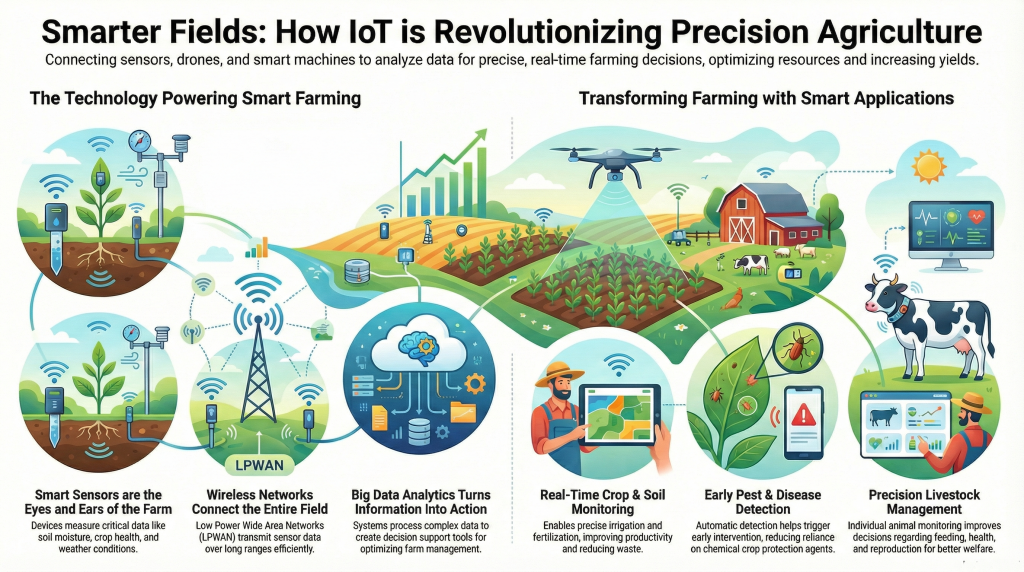
The global food system faces an unprecedented challenge. With a projected population of 10 billion by 2050 and climate volatility increasing agricultural unpredictability, farmers can no longer rely on traditional, one-size-fits-all approaches to crop management. Enter precision agriculture (PA)—a transformative model powered by the Internet of Things (IoT) that promises to optimize every aspect of farm operations while protecting our planet’s limited resources.
This comprehensive guide explores how IoT technologies are reshaping farming practices, the specific innovations driving change, and the emerging opportunities and obstacles that will define the agricultural sector’s future.
What Is Precision Agriculture, and Why Does It Matter?
Precision agriculture represents a fundamental shift in how we manage crops and livestock. Rather than applying resources uniformly across entire fields, PA is a site-specific crop management model that leverages IoT sensors, actuators, and artificial intelligence to deliver the right input—whether that’s water, fertilizer, pesticides, or labor—at the right place and time.
The goal is deceptively simple yet profoundly impactful: optimize returns on inputs while ensuring environmental and economic sustainability. In an era of resource scarcity and climate pressure, this approach isn’t just an efficiency gain—it’s a necessity.
Consider a farmer managing a 500-acre corn field. Traditional methods might apply the same amount of nitrogen fertilizer across the entire property. However, soil nutrient levels vary significantly based on topography, drainage patterns, and previous crop rotations. With PA, farmers can apply optimal fertilizer rates to each micro-zone, reducing waste, lowering costs, and minimizing runoff that pollutes waterways. The result: higher yields, lower input costs, and a smaller environmental footprint.
The IoT Technology Stack Driving Precision Agriculture
The magic of precision agriculture lies in its integrated technology ecosystem. Here’s how the key components work together:
Sensors: Eyes and Ears in the Field
Modern PA relies on three categories of sensors that continuously monitor crop and environmental conditions:
Crop Sensors measure plant health directly through leaf reflectance—the amount of light vegetation reflects at specific wavelengths. Healthy crops reflect light differently than stressed or nutrient-deficient plants, allowing farmers to detect problems before they’re visible to the naked eye.
Soil Sensors track moisture levels, temperature, and salinity in real-time. For arid and semi-arid regions facing water scarcity, soil moisture data is invaluable for irrigation scheduling, ensuring every drop of water counts. These sensors also prevent nutrient limitation by revealing when soil lacks critical elements like nitrogen, phosphorus, and potassium.
Weather Sensors provide localized microclimate data—rainfall, humidity, wind speed, and temperature—which are essential for disease and pest prediction models.
Remote Sensing: Seeing Across Acres
Tools like Trimble GreenSeeker and CropScan use infrared light to measure the Leaf Area Index (LAI)—essentially the amount of leaf surface relative to ground area—and overall crop health. These remote sensing devices eliminate the need for manual scouting across hundreds of acres, providing actionable data in minutes rather than days.
Communication Infrastructure: Connecting the Farm
A sensor network is only as useful as its ability to transmit data reliably. Low Power Wide Area Networks (LPWAN) and Sub-1 GHz communication designs solve a critical problem in agricultural IoT: farms are often located in remote areas with limited connectivity. These technologies provide long-range, low-power communication that can reach across several miles while consuming minimal battery power—crucial for systems that must operate independently for months.
Big Data and Decision Support Systems
The true intelligence of modern PA emerges when data from multiple sources converge. Aggregating information from satellites, GPS tracking, ground-level sensors, and historical records creates comprehensive datasets that power Decision Support Systems (DSS). These AI-driven platforms analyze patterns to predict pest outbreaks, optimize irrigation schedules, forecast yield variability, and recommend management interventions—transforming raw data into actionable decisions.
Real-World Applications Transforming Agriculture
Soil Monitoring: Foundation for Sustainability
Water scarcity represents one of agriculture’s greatest challenges, particularly in arid and semi-arid regions where irrigation accounts for up to 70% of freshwater consumption. Soil monitoring systems address this directly by measuring soil moisture and identifying the precise moment when irrigation is needed—not before, not after, but exactly when plants require water.
Beyond water management, continuous soil monitoring prevents nutrient limitation by tracking macro and micronutrient availability. This enables variable-rate fertilizer application, reducing the 30-40% of applied fertilizers that typically aren’t used by crops while minimizing environmental pollution.
Pest and Disease Detection: Moving Beyond Manual Scouting
Traditionally, pest management required farmers or scouts to physically walk fields, visually inspecting plants for signs of disease or insect damage. This labor-intensive approach often misses early-stage infestations, forcing farmers to apply broad-spectrum pesticides as a preventive measure.
The shift to “hypsometric plant sensing”—using spectral reflectance and multispectral imaging to detect plant stress patterns—enables early detection of pest and disease issues before symptoms become visible. This precision allows farmers to:
- Apply targeted treatments only when and where needed
- Reduce overall pesticide use by 20-40%
- Minimize the development of pesticide-resistant insect populations
- Protect beneficial insects and maintain ecosystem health
Livestock Monitoring: Individual Animal Health at Scale
PA isn’t limited to crops. Modern sensor technology monitors individual animal health, detecting early signs of disease, tracking water and feed consumption, and optimizing rotational grazing patterns. Wearable sensors on cattle can alert farmers to physiological changes indicating illness, enabling intervention before animals become seriously sick and reducing losses in livestock operations.
The Challenges Slowing Adoption
Despite its transformative potential, precision agriculture faces significant barriers that researchers, policymakers, and industry leaders must address.
Data Security and Privacy: As farms become digitally connected, they become potential targets for cyberattacks. Hackers could disrupt operations, manipulate data, or steal proprietary information about crop genetics and management practices. Developing robust cybersecurity protocols is essential for farmer confidence and system reliability.
High Research and Implementation Costs: The capital investment required to deploy sensor networks, establish data infrastructure, and train personnel remains prohibitively expensive for many smallholder farmers in developing regions. This threatens to widen the technology gap between large commercial operations and smaller farms.
Interoperability: Perhaps the most vexing challenge, interoperability refers to the ability of different IoT devices and systems—manufactured by different companies, using different protocols—to work together seamlessly. Currently, PA systems often operate in silos, with sensors from one manufacturer unable to communicate with software platforms from another. This fragmentation limits the ability to build comprehensive, integrated farm management systems and forces farmers to commit to specific vendor ecosystems.
Related Article: Agricultural Intelligence: The Ultimate Guide to AI-Driven Performance and the Future of Smart Farming
Emerging Trends Shaping Tomorrow’s Farms
The Evolution Toward the “Web of Things”
The IoT landscape is gradually shifting from isolated device networks toward an integrated “Web of Things”—an open ecosystem where devices, systems, and platforms interact seamlessly using standardized protocols. This democratization of agricultural data will enable farmers to choose best-of-breed solutions for each function rather than accepting compromise systems from a single vendor.
Big Data for Risk Management and Market Stability
Beyond field-level optimization, aggregated agricultural data enables broader market-level insights. By analyzing production patterns across regions, climate conditions, and supply chains, DSS platforms can identify supply and demand imbalances early in the growing season—months before harvest.
This capability enables “price smoothing”: using forward contracts, futures markets, and risk-based insurance pricing to stabilize commodity prices and reduce volatility that disproportionately harms farmers and global food security. Exporters and importers benefit from improved production forecasting, enabling better inventory management and logistical planning.
Why Researchers Should Engage with Precision Agriculture
The precision agriculture space represents a frontier for multiple academic disciplines. Researchers will find:
Technical Frameworks that illuminate the complete “research pipeline” in PA, from sensor design and cloud computing infrastructure to web-based decision support artifacts. Understanding how biophysical sensor systems integrate with agronomic knowledge and economic models provides insights applicable across multiple domains.
Methodological Innovation opportunities in bridging biophysical and socioeconomic concepts. Implementing PA at scale requires integrating soil physics, plant physiology, microeconomics, and behavioral science. An emerging 8-step implementation flowchart for deploying IoT in agricultural practices provides a tested framework for other complex, site-specific technology deployments.
Critical Research Gaps remain in combining different sensory data streams over time to generate operational advice. Current systems excel at answering questions like “Is this field water-stressed right now?” but struggle with temporal integration: “Given the soil conditions today, the disease pressure trajectory, and the weather forecast, what action sequence minimizes losses while preserving yield potential?”
Why Importers and Exporters Should Pay Attention
For the global trade sector, precision agriculture offers concrete value propositions:
Logistical Optimization: PA’s improved yield prediction capability enables importers and exporters to forecast crop production with greater accuracy months before harvest. This precision planning optimizes storage requirements, transport scheduling, and supply chain positioning, reducing costly inefficiencies and spoilage.
Market Stability and Price Resilience: Big data analytics that identify regional supply and demand imbalances create opportunities for “price smoothing” through forward contracting. Rather than volatile price swings that squeeze margins and create uncertainty, traders can use production forecasts to establish stable pricing mechanisms that reward producers while protecting buyers from price shocks.
Consistent Product Quality and Quantity: Variable-rate input application improves consistency across harvested crops. Produce meets more uniform quality standards, reducing rejections and returns while commanding premium prices in international markets. This consistency is particularly valuable for buyers requiring large, uniform shipments.
The Path Forward: Building a Smart Agriculture Future
Precision agriculture represents far more than incremental efficiency gains. It’s a fundamental reimagining of how humanity feeds itself—shifting from exploitative resource extraction to regenerative, data-driven stewardship.
The transition won’t be instantaneous. Challenges around interoperability, data security, and cost will require continued innovation and policy support. Yet the trajectory is clear: farms are becoming intelligent systems, data is becoming a primary agricultural resource, and the marriage of agronomic knowledge with IoT technology is creating opportunities that were unimaginable a decade ago.
Key Takeaways
- Precision agriculture uses IoT sensors, actuators, and AI to optimize resource application at field micro-zones, improving yields while reducing environmental impact
- The technology stack—sensors, remote sensing, LPWAN communication, and decision support systems— enables data-driven management at unprecedented scale
- Real-world applications in soil monitoring, pest detection, and livestock management are already delivering measurable improvements in sustainability and profitability
- Critical challenges in data security, cost, and interoperability require continued focus from researchers and industry leaders
- Emerging trends toward integrated “Web of Things” and big data for risk management will accelerate adoption and unlock new value for producers, traders, and consumers
The Question for Global Food Security
As you reflect on precision agriculture’s potential, consider this: How will Smart Farming reshape global food security over the next two decades? Will the technology democratize farming and strengthen smallholder productivity in developing regions, or will it deepen divides between well-resourced industrial operations and under-equipped producers? The answer depends on decisions we make today about standards, accessibility, and commitment to equitable innovation.
The future of farming isn’t predetermined. It’s being written by researchers pushing technical boundaries, farmers embracing data-driven management, and visionaries working to ensure that the tools of tomorrow serve all of agriculture’s stakeholders.
The question now is: How will you participate in that transformation?
References & Technical Verification
1. About the Source Research
The foundational research for this discussion is titled “The integration of Internet of Things (IoT) in precision agriculture,” authored by Zaiba Khan from the Department of Computer Science at RNB Global University, Bikaner, Rajasthan, India. Published in the journal Agricultural and Biological Research (AGBIR) in 2024 (Volume 40, Issue 4), this review article synthesizes the current state of Smart Farming. The paper explores critical themes including the Web of Things (WoT), Big Data Analytics, Wireless Communication Systems like LPWAN, and the deployment of Sensors and Actuators for site-specific crop management.
2. Why This Research Matters for Our Readers
• For Researchers: The paper addresses the critical “research gap” regarding the under-explored application of IoT in Precision Agriculture (PA) by defining a specific “research pipeline” that includes monitoring, control, and Knowledge Discovery through Big Data analytics. It introduces the technical taxonomy of IoTA (Internet of Things specific to Agriculture) and provides a framework for developing Decision Support Systems (DSS) that integrate heterogeneous data from satellites, GPS, and terrestrial or satellite communication models.
• For Trade Professionals (Importers & Exporters): This research provides evidence-based insights into supply chain efficiency by demonstrating how early yield prediction allows for the optimization of logistics for storage and transport, thereby reducing post-harvest physical damage. Furthermore, the paper highlights how Big Data applications enable “price smoothing” and the use of forward contracts, allowing trade professionals to mitigate risks associated with volatile market conditions and implement better risk-based pricing for agricultural insurance.
3. Formal Citation for Authenticity
Khan Z. The integration of Internet of Things (IoT) in precision agriculture. AGBIR. 2024;40(4):1194-1197.
4. Direct Access & DOI
The full technical paper and its findings can be verified through the Digital Object Identifier (DOI) system. DOI: https://doi.org/10.35248/0970-1907.24.40.1194-1197
