

Introduction: Why Agriculture Still Matters in a Digital Age
In our hyperconnected world, where food appears on demand through apps like Foodpanda and Chaldal, it’s easy to forget where our meals actually come from. Fresh vegetables seem like products manufactured by online grocery stores. Fish and meat feel like retail inventory rather than the result of hard work by farmers and fishermen across Bangladesh.
But this disconnect is dangerous.
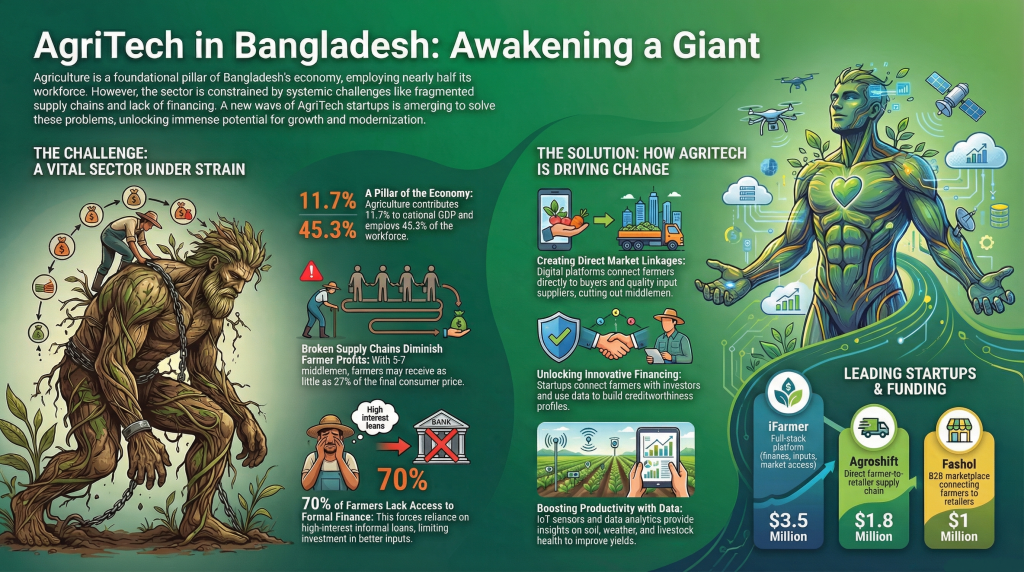
Agriculture remains the backbone of Bangladesh’s economy, employing 45.3% of the workforce and contributing 11.66% to the nation’s GDP. More importantly, it’s the ultimate hedge against existential threats—pandemics, climate disasters, and geopolitical conflicts. The COVID-19 pandemic reminded us of this truth: when global supply chains collapsed, it was local agriculture that kept people fed.
Yet despite its critical importance, Bangladesh’s agriculture sector faces enormous challenges: fragmented supply chains, limited access to finance, information asymmetry, productivity constraints, and climate vulnerability. These aren’t just economic problems—they’re human problems affecting millions of farming families trying to earn a dignified living.
This is where agritech enters the story.
Over the past decade, a growing crop of technology-driven startups has emerged to transform Bangladesh’s “slumbering giant” of agriculture. These innovators are building solutions that connect farmers directly to markets, provide affordable financing, deliver real-time advisory services, and use IoT sensors to monitor everything from soil health to cattle wellbeing.
The sector has raised nearly $14 million in total funding—modest compared to neighboring India, but significant for Bangladesh’s nascent startup ecosystem. More importantly, these companies are addressing real pain points: ensuring farmers get fair prices, reducing 30-40% wastage in supply chains, democratizing access to quality inputs, and making precision agriculture affordable for smallholders.
This comprehensive guide explores the current state of Bangladesh’s agritech landscape, the opportunities ahead, and why this sector deserves far more attention from entrepreneurs, investors, policymakers, and anyone who cares about building a future where no one worries about food.
Part 1: Understanding Agriculture’s Critical Role in Bangladesh
The Numbers Tell a Powerful Story
Let’s start with facts that underscore why agriculture isn’t just another sector—it’s the foundation of Bangladesh’s socio-economic fabric:
Economic Contribution:
- In 2021-22, agriculture contributed 11.66% to Bangladesh’s total GDP
- The sector employed 45.3% of the total workforce in 2022
- Approximately 70% of the population depends on agriculture directly or indirectly for their livelihood
- It’s the single largest employer in the country—no other industry comes close
Market Size:
- Agricultural product market: $47.54 billion (2021)
- Agro-food processing industry: 1.7% of GDP, employing 250,000 people
- Seed market: $245 million (2023), projected to reach $305 million by 2028
- Agricultural machinery market: $1.2 billion (2019)
- Animal feed market: 6.3-6.4 million tonnes annual demand, valued at $2.5 billion
Export Earnings:
- Agricultural exports generated $1.41 billion in FY 2018-19
- Major exports include frozen fish, shrimp, tea, spices, and fruits
- Primary markets: EU, US, Middle East, and Gulf countries
Beyond the Numbers: Agriculture’s Second-Order Impacts
What makes agriculture truly irreplaceable are its cascading effects across the economy:
Raw Material Backbone: Agriculture supplies essential raw materials to various industries, particularly food processing, which contributes approximately 13% to total manufacturing production and employs 6.5% of the manufacturing labor force. The domestic packaged food sector alone was worth $5.2 billion in 2018 and is expected to grow to $7.3 billion by 2023.
Rural Economic Engine: In a country where millions still live in villages, agriculture serves as the primary driver of economic linkages in rural regions. It’s fundamental to poverty reduction—when farmers earn better incomes, entire village economies benefit through multiplier effects.
Food Security Shield: For a densely populated nation of 170+ million people, food security isn’t abstract policy—it’s existential. A thriving agriculture sector ensures the country can feed itself, reducing dependency on volatile international markets.
Climate and Pandemic Resilience: As we witnessed during COVID-19, when global supply chains fractured, local agriculture kept Bangladesh fed. In an era of increasing climate uncertainty and geopolitical tensions, this self-sufficiency is priceless.
The Paradox: Critical Yet Challenged
Despite this overwhelming importance, agriculture faces a gauntlet of challenges that threaten its sustainability:
- Productivity constraints in the face of growing population
- Fragmented supply chains with 5-7 layers of middlemen eating into farmer incomes
- Limited access to finance—70% of farmers lack formal financing options
- Climate vulnerability exacerbated by declining arable land
- Labor shortages as young people migrate to cities for industrial jobs
- Technology adoption gaps that leave farmers without critical data and insights
- Information asymmetry causing extreme price volatility
These aren’t just statistics—they represent daily struggles for millions of farming families trying to make an honest living from the land.
Part 2: The Agritech Opportunity—Massive and Largely Untapped
Market Potential Across the Value Chain
The opportunity for technology-driven innovation in Bangladesh’s agriculture sector is staggering when you examine each segment:
Agricultural Products Market: $47.54 Billion
This encompasses the total value of agricultural output—rice, potatoes, sugar, fruits, vegetables, and spices. Bangladesh produced approximately 70 million metric tons of agricultural products in 2019-20, with rice, potatoes, and sugar accounting for 80% of output.
The growth trajectory is compelling. The packaged food sector is expanding at 6% annually, while processed fruits, vegetables, seafood, and meat are growing at 8%, 13%, and 13% respectively. This presents opportunities for agritech players working on output market linkages, supply chain solutions, and farm-to-table businesses.
Agricultural Inputs Market: Multi-Billion Dollar Opportunity
- Seeds: $245 million market growing at 4.48% CAGR
- Fertilizers: 6.9 million tonnes consumed annually—imported urea, triple superphosphate, diammonium phosphate, and MOP
- Pesticides: 4,636 tonnes granular insecticides, 2,240 tonnes powder, 6,345 tonnes liquid, plus 18,000 tonnes of fungicides
- Agricultural Machinery: $1.2 billion market driven by labor shortages and mechanization needs
- Animal Feed: 6.3-6.4 million tonnes annual demand, $2.5 billion market size
Each of these input segments suffers from supply chain fragmentation, quality inconsistency, and accessibility challenges—perfect problems for tech-enabled solutions to address.
Financial Services: The Sleeping Giant
With 70% of farmers lacking access to formal finance and 80% being smallholders dependent on high-interest informal loans, the opportunity for agri-fintech is enormous. Farmers need credit for inputs, equipment, land improvements, and working capital—yet traditional banks view them as too risky.
This is where data-driven credit scoring, alternative collateral mechanisms, and investor-farmer matching platforms can transform lives and unlock billions in economic value.
The Pain Points: Where Agritech Creates Value
Understanding where the current system breaks down reveals where innovation can have the greatest impact:
1. Fragmented Supply Chains Crush Farmer Incomes
Currently, there are 5-7 layers of middlemen between farmers and consumers. The result? Farmers receive just 30% of the final selling price on average. In some cases, it’s even worse:
- Red amaranth: 27%
- Pineapples: 44%
- Tomatoes: 45%
- Cucumbers: 46%
This fragmentation also causes 30-40% wastage, price volatility, and lack of traceability. Agritech players addressing output market linkages directly tackle this problem by connecting farmers to retailers or consumers, eliminating intermediaries and improving price transparency.
2. Input Quality and Accessibility Problems
High-quality seeds, fertilizers, and pesticides are often expensive and not widely available, especially in remote areas. Farmers frequently choose lower-quality inputs because they’re cheaper or come with accessible (though expensive) credit from local dealers.
Limited awareness about proper input usage leads to overuse of fertilizers and pesticides, degrading soil quality and increasing costs. Input price volatility further complicates planning.
Agritech solutions here include curated marketplaces, advisory services bundled with inputs, and credit facilities that make quality inputs affordable.
3. The Finance Gap
Almost 70% of farmers can’t access formal financing. They rely on:
- Local moneylenders at exorbitant interest rates (often 50-100% annually)
- Input dealers who provide credit tied to product purchases
- Family and community loans
This lack of capital prevents investments in productivity-enhancing technologies, better seeds, equipment, or land improvements.
Agri-fintech platforms solve this by:
- Creating data-driven creditworthiness profiles
- Connecting farmers with retail and institutional investors
- Using alternative data (satellite imagery, transaction history) for risk assessment
- Providing crop and livestock insurance to reduce risk
4. Productivity Challenges Amid Growing Population
Bangladesh has 1,239.7 people per square kilometer—one of the world’s highest population densities. Arable land is shrinking due to urbanization, while the population continues growing.
Increasing productivity isn’t optional—it’s essential for food security. This requires:
- Mechanization to address labor shortages
- Climate-resilient seed varieties (drought-resistant, submergence-tolerant, salt-tolerant)
- Precision agriculture to optimize resource use
- Data-driven insights on crop selection, planting timing, and pest management
Agritech plays addressing productivity through IoT sensors, satellite data, weather forecasting, and AI-driven advisory have enormous potential—though this segment currently has fewer players than market linkage solutions.
5. Information Asymmetry
Farmers often lack real-time information about:
- Market prices for their produce
- Demand forecasts
- Weather patterns
- Pest and disease threats
- Best agricultural practices
- New seed varieties or techniques
This information gap leaves them vulnerable to exploitation by middlemen and prevents optimal decision-making. Mobile apps, SMS services, and digital platforms delivering timely, localized information can bridge this gap.
Part 3: The Current Agritech Landscape in Bangladesh
Overview: Nascent but Growing Fast
Bangladesh’s agritech sector is less than a decade old, with the first significant players emerging around 2015-2018. Despite this short history, the sector has made meaningful progress:
- Total funding: Approximately $14 million across all agritech startups
- Number of players: 20-30 significant startups across various segments
- Growth acceleration: Most funding activity occurred in the last 2-3 years
- Dominant segments: Output market linkages and financial services
While these numbers pale compared to India (billions invested) or Indonesia, they’re significant within Bangladesh’s challenging startup funding environment.
Key Segments and Leading Players
Let’s examine each major agritech segment, the problems being solved, and the companies leading the charge:
1. Output Market Linkages: Connecting Farms to Tables
This is the most crowded segment with the highest number of players. These companies address supply chain inefficiencies by connecting farmers directly to retailers or consumers.
Business Model: Agritech players use digital platforms to take orders from retailers or consumers, collect produce from farmers through collection centers, sort and grade products, and deliver directly—eliminating 3-5 intermediary layers.
Value Created:
- Farmers get 50-70% of final price (vs. 30% previously)
- 30-40% reduction in wastage through better logistics
- Price transparency and demand visibility
- Consistent quality through grading and sorting
- Traceability for food safety
Leading Players:
iFarmer (Funding: $3.5M) – Started as an agri-fintech platform but evolved into a full-stack player. Now handles financing, input supply, advisory, and output market linkages. Claims to work with 99,000 farmers and has facilitated over BDT 2.24 billion in funding support.
Agroshift (Funding: $1.8M) – B2B player taking orders from micro-retailers and customers, collecting produce through established collection centers, and delivering directly. Raised significant pre-seed funding from international investors including Shorooq Partners.
Fashol (Funding: $1M) – Wholesale agriculture marketplace connecting farmers to retailers. Collects products from different regions, sorts them using proprietary methods, and delivers to partner retailers. Built a thriving B2B business with strong unit economics.
Khaas Food – Operates both e-commerce and physical retail channels. Works directly with farmers for collection and sells through multiple touchpoints. Also involved in contract farming for certain products.
Chaldal (CDVN segment) – The online grocery leader has built substantial agriculture operations, working directly with farmers to ensure supply of fresh produce. Leverages its massive customer base and logistics network.
Other Notable Players: NeoFarmers, GhorerBazar, GreenGrocery (raised $100K), Premium Fruits, DeshiFarmer
Key Insights:
- This segment has attracted the most funding and attention
- Many players use a “phygital” model—combining digital platforms with physical collection centers
- Maintaining consistent quality at scale remains the biggest challenge
- Unit economics work when wastage is minimized and volumes are high
- Consolidation likely as similar business models compete
2. Input Market Linkages: Quality Inputs, Fair Prices, Expert Advisory
This segment addresses challenges around access to quality agricultural inputs—seeds, fertilizers, pesticides, animal feed, and machinery.
Business Model: Agritech players work directly with manufacturers and distributors to aggregate inputs, then collaborate with retail networks to distribute to farmers. They add value through:
- Curated selection ensuring quality
- Advisory services for proper input selection and usage
- Credit facilities to make quality inputs affordable
- Data collection on demand patterns
Value Created:
- Access to certified, high-quality inputs in remote areas
- 10-20% cost savings through supply chain efficiency
- Reduced overuse of pesticides/fertilizers through expert advisory
- Credit facilities enabling better input purchases
- Data-driven inventory management reducing stockouts
Leading Players:
Bhalo Social Enterprise – Omnichannel marketplace offering smallholder farmers access to high-quality inputs. Works with manufacturers and distributors to aggregate products, partners with retail outlets as distribution points, and provides advisory services to help farmers choose the right inputs. Also facilitates credit from financial institutions.
iFarmer – Also operates in this segment as part of its full-stack approach, bundling input supply with financing and advisory.
ACI Fosholi App – Traditional agribusiness giant ACI launched this Android app providing access to inputs, services, information, and solutions in one platform. Represents how established players are entering the digital space.
Key Insights:
- Advisory services are crucial differentiators—not just selling inputs but educating farmers
- Credit bundling increases stickiness and market share
- Partnership with retail networks provides physical touchpoints essential for farmer trust
- Data collection enables predictive models for demand forecasting
- Margins are thin, requiring scale or additional revenue streams
3. Financial Services: Unlocking Capital for Farmers
With 70% of farmers lacking formal finance access, agri-fintech represents a massive opportunity. Players in this space provide credit, insurance, and investment matching services.
Business Models:
- Crowdfunding/Investment Matching: Connect farmers with retail and institutional investors who fund specific agricultural projects
- Direct Lending: Use alternative data for credit scoring and lend directly
- Insurance: Provide crop or livestock insurance using IoT monitoring and data
- Revenue-Based Financing: Invest in farming cycles and share in harvest proceeds
Value Created:
- Access to affordable capital (10-15% interest vs. 50-100% from moneylenders)
- Risk mitigation through insurance products
- Investment opportunities for retail investors seeking impact
- Data-driven credit assessment reducing default rates
- Financial inclusion for underserved farming communities
Leading Players:
iFarmer (Funding: $3.5M) – Started as agri-fintech connecting farmers with investors. Evolved into full-stack but financing remains core. Has facilitated over BDT 2.24 billion in funding support for farmers.
WeGro (Funding: $100K) – Focuses specifically on connecting individual and institutional financiers with farmers and their agricultural projects. Backed by Accelerating Asia.
InsureCow – Provides “360° technology-powered cattle insurance and wellbeing monitoring platform.” Uses data from monitoring to offer insurance products.
Adorsho PraniSheba – Assists marginal cattle farmers with IoT-based cattle identification and wellbeing monitoring, insurance, access to finance, crowdfunding, online veterinary services, and market linkage support.
Key Insights:
- Data is the unlock—IoT sensors, satellite imagery, transaction history enable credit scoring
- Insurance products reduce risk for both farmers and lenders
- Returns for investors must be compelling while keeping farmer costs reasonable
- Default risk management requires deep agricultural expertise
- Regulatory clarity needed for crowdfunding and alternative lending models
4. Precision Agriculture and Farm Management: Data-Driven Productivity
This segment uses advanced technologies—IoT sensors, drones, satellite imagery, AI/ML—to provide farmers with insights that improve yields, reduce resource waste, and optimize decision-making.
Business Model: Subscription-based services providing:
- Soil health monitoring and analysis
- Weather forecasting and alerts
- Crop health monitoring via satellite or drones
- Livestock health tracking via IoT sensors
- AI-driven recommendations for planting, irrigation, pest control
- Yield prediction and harvest planning
Value Created:
- 15-30% yield improvements through optimized practices
- 20-40% reduction in water and fertilizer usage
- Early pest/disease detection preventing crop losses
- Data-driven crop selection based on soil and climate
- Livestock health monitoring reducing mortality
Leading Players:
iPage – Provides farmers with easy access to agricultural information for better productivity and enhanced profitability. Focuses on timely, localized advisory.
Adorsho PraniSheba – IoT-enabled solution to monitor cattle health in real-time, generating health insights used for insurance and credit decisions.
iFarmer – Also working on precision farming and advisory products as part of its platform play.
Key Insights:
- This segment is underdeveloped in Bangladesh compared to India or US
- Adoption challenge: farmers must see clear ROI to justify subscription costs
- Requires significant upfront technology investment
- Data collection and analysis expertise is scarce
- Government support could accelerate adoption
- Massive long-term potential as Bangladesh faces productivity and climate challenges
5. Aquaculture: Organizing the Fish and Meat Supply Chain
Bangladesh has a significant fish and meat market, but the supply chain remains largely unorganized. Several startups are working to bring structure, quality assurance, and efficiency to this segment.
Leading Players:
- Protein Market
- Fishmart
- BengalFish
- SeaFishBD
These players work on sourcing, quality control, cold chain logistics, and retail distribution of fish and meat products.
Investment Landscape: Growing but Still Limited
Total disclosed funding for Bangladesh agritech startups stands at approximately $14 million as of September 2023. This is distributed across:
Top Funded Startups:
- iFarmer – $3.5M (IDLC Ventures, Millville Opportunities Fund, Startup Bangladesh, Accelerating Asia, Falcon Network)
- Agroshift – $1.8M (Shorooq Partners, Anchorless Bangladesh, Ratio Ventures, Sketchnote Partners, Sabr Capital)
- Fashol – $1M (DIVC, SOSV, South Asia Tech Partners)
- WeGro – $100K (Biniyog Briddhi, Accelerating Asia)
- GreenGrocery – $100K (Multiple angel investors)
Active Investors in Bangladesh Agritech:
- Startup Bangladesh Limited
- Millville Opportunities Management
- South Asia Tech Partners
- IDLC Finance
- DEKKO ISHO
- Zayn Capital
- Falcon Network
- Accelerating Asia
- Sketchnote Partners
- Anchorless Bangladesh
- Ratio Ventures
- Sabr Capital
- Shorooq Partners
- UNCDF
- Bill and Melinda Gates Foundation
Investment Trends:
- Most funding concentrated in 2021-2023
- Output market linkage and financial services attracting most capital
- International investors increasingly interested
- Pre-seed and seed stage dominate—limited Series A+ activity
- Impact investors particularly active given social returns
Dominant Business Models and Technology Stacks
Revenue Models:
- Margin-Based: Market linkage players earn from buying and selling spreads
- Commission-Based: Financial services earn from transaction fees or interest
- Subscription-Based: Precision agriculture and SaaS tools charge recurring fees
- Hybrid: Many players combine models as they expand horizontally
Technology Stacks Commonly Used:
- Data Analytics & Machine Learning: For credit scoring, demand forecasting, yield prediction, price optimization
- IoT Sensors: For soil monitoring, livestock health tracking, environmental conditions
- Mobile Apps: For farmer interfaces, order taking, information delivery
- Web Platforms: For B2B customers, investor matching, backend management
- Satellite Imagery: For crop health monitoring, land assessment
- Cloud Infrastructure: For data storage and processing
- AI/ML Models: For recommendations, anomaly detection, predictive analytics
Part 4: Critical Observations and Challenges
What’s Working
1. Market Validation is Clear The $14 million raised and growing investor interest validate that agritech solves real problems. Companies like iFarmer, Agroshift, and Fashol have demonstrated product-market fit with strong unit economics.
2. “Phygital” Model Proves Effective Combining digital platforms with physical infrastructure (collection centers, retail partnerships, field agents) builds trust and addresses last-mile challenges in Bangladesh’s context.
3. End-to-End Platform Play Emerging Companies like iFarmer show that owning the full farmer relationship—finance, inputs, advisory, output linkage—creates defensible moats and better margins than single-vertical plays.
4. Traditional Players Paying Attention ACI’s Fosholi app and Chaldal’s CDVN initiative show that established agriculture and retail companies recognize the disruption potential and are responding.
What’s Not Working
1. Homogeneous Business Models Too many companies operate in output market linkages with similar approaches. This leads to:
- Price competition eroding margins
- Customer acquisition cost wars
- Limited differentiation
- Inevitable consolidation ahead
2. Insufficient Focus on Productivity While market linkage solutions help farmers get better prices, they don’t address the fundamental productivity challenge. Bangladesh needs more innovation in:
- Climate-resilient seeds
- Precision agriculture for smallholders
- Affordable mechanization
- Soil health improvement
- Water management
3. Funding Remains a Major Bottleneck $14 million total funding is minuscule compared to the opportunity and compared to India or Indonesia. This limits:
- Technology R&D investment
- Geographic expansion
- Talent acquisition
- Marketing and customer education
- Pilot projects for innovative solutions
4. Limited Academia-Industry Collaboration Research institutions and universities are disconnected from agritech startups. This prevents:
- Commercialization of research innovations
- Access to agricultural data and research facilities
- Talent pipeline development
- Joint R&D projects
5. Regulatory Uncertainty Crowdfunding, alternative lending, and digital agriculture face unclear regulatory frameworks, creating risks for startups and investors.
The Road Ahead: What’s Needed
1. More Diverse Startups Across the Value Chain The sector needs innovation in:
- Precision agriculture and farm automation
- Climate-resilient agricultural technologies
- Post-harvest processing and value addition
- Agricultural robotics and drones
- Alternative proteins and sustainable farming
- Hydroponics and vertical farming for urban areas
2. Greater Investment—Especially Local Capital Bangladeshi conglomerates and HNIs should invest in agritech rather than building in-house solutions. Investment enables:
- R&D for breakthrough innovations
- Scale-up of proven models
- Talent development
- Market education
3. Ecosystem Building Create agritech innovation clusters bringing together:
- Startups
- Research institutions (BARI, agricultural universities)
- Traditional agriculture companies
- Food processing companies
- Government agencies
- Impact investors
- Technology providers
4. Government Support Smart agriculture is already part of government industrial policy. Specific needs:
- Subsidies or grants for precision agriculture adoption
- Access to government research facilities and data
- Regulatory clarity for agri-fintech
- Procurement from agritech platforms
- Incubation and acceleration programs
5. Cross-Border Learning and Collaboration Bangladesh can accelerate development by learning from more mature markets:
- India’s agritech ecosystem (DeHaat, Ninjacart, AgroStar)
- Indonesia’s agricultural digitization
- Israel’s precision agriculture innovations
- Netherlands’ sustainable farming technologies
6. Long-Term Sustainable Orientation Given Bangladesh’s funding constraints and the long cycles in agriculture, startups should:
- Prioritize path to profitability over growth-at-all-costs
- Build defensible competitive advantages
- Focus on depth (integrated solutions) over breadth (shallow aggregation)
- Demonstrate sustainable unit economics before aggressive scaling
Part 5: The Future—Why Agritech Matters More Than Ever
Megatrends Driving Agritech Importance
1. Climate Change Intensifies Agricultural Challenges Bangladesh is among the most climate-vulnerable nations. Rising sea levels, increased flooding, droughts, and unpredictable weather patterns threaten food security. Agritech solutions—climate-resilient seeds, precision irrigation, weather forecasting, crop insurance—are essential for adaptation.
2. Urbanization and Middle-Class Growth As 30 million Bangladeshis enter the middle class by 2030, demand for high-quality, safe, traceable food will surge. Agritech enables the transparency, quality control, and logistics needed to meet this demand.
3. Labor Migration Creates Mechanization Imperative Young people increasingly migrate from farms to cities for industrial jobs. This labor shortage requires mechanization and automation—areas where agritech can provide rental models, shared services, and smart equipment.
4. Food Security as National Priority Global conflicts, supply chain fragilities, and climate disasters make food self-sufficiency strategic. Technology that increases productivity and reduces waste directly enhances national security.
5. Digital Infrastructure Maturation Growing smartphone penetration (80%+ expected by 2025), internet access (40%+ penetration), mobile financial services adoption, and digital literacy create the foundation for agritech solutions to scale.
The Ultimate Opportunity: Agriculture is Anti-Fragile
In his book Antifragile, Nassim Nicholas Taleb describes systems that gain from disorder and shocks. Agriculture is the ultimate antifragile sector:
- Existential Importance: People need food regardless of economic conditions
- Resilience to Shocks: Local agriculture thrives when global systems fail
- Long-Term Relevance: Will remain critical for centuries
- Crisis Alpha: Performs well during pandemics, wars, climate disasters
- Infinite Time Horizon: Unlike tech trends, farming isn’t going away
For long-term thinkers and mission-driven entrepreneurs, agriculture offers the rare combination of:
- Solving critically important problems
- Building generational businesses
- Creating massive social impact
- Participating in an anti-fragile sector
- Working on hard problems that others avoid (the “schlep blindness” opportunity)
Overcoming Schlep Blindness
Paul Graham, founder of Y Combinator, coined the term “schlep blindness”—the tendency to avoid tedious, unglamorous tasks even when they’re important and lucrative. Agriculture suffers from this.
Compared to fintech, e-commerce, or AI, agriculture seems:
- Boring: Not sexy or trendy
- Difficult: Requires domain expertise, dealing with weather, biology, logistics
- Slow: Long cycles, not “move fast and break things”
- Unglamorous: Dirty hands, rural work, not Silicon Valley cool
But this perception creates opportunity. Because agriculture is overlooked, there’s:
- Less competition from top talent
- Higher impact when you succeed
- Greater gratitude from customers whose lives you transform
- Defensive moats built through domain expertise and operational excellence
- Long-term value creation in a sector with staying power
The most consequential companies are often built at the intersection of importance and difficulty. Agriculture sits squarely in that sweet spot.
Conclusion: A Call to Action
Bangladesh’s agritech sector stands at an inflection point. The foundation has been laid—early companies have proven models work, raised capital, and demonstrated impact. Government policy is supportive. Digital infrastructure is maturing. Farmer awareness is growing.
What’s needed now is acceleration across five dimensions:
1. Entrepreneurial Talent: More founders, especially those with deep agricultural domain expertise combined with technology chops, should build in this space.
2. Capital Deployment: Investors—both impact-focused and commercial—should recognize the massive opportunity and allocate more capital to agritech. Local conglomerates should invest in startups rather than building inferior in-house solutions.
3. Ecosystem Development: Stakeholders must collaborate to create innovation clusters connecting startups, research institutions, traditional agriculture companies, government, and investors.
4. Regulatory Clarity: Government should provide clear frameworks for agri-fintech, digital agriculture, and related innovations while supporting the sector through subsidies, access to research facilities, and procurement.
5. Focus on Fundamentals: While market linkages are important, greater attention must go to productivity, climate resilience, mechanization, and breakthrough agricultural innovations.
Bangladesh’s agriculture sector is a slumbering giant. The agritech pioneers have begun the awakening. The next decade will determine whether this potential translates into reality—transforming millions of lives, ensuring food security for generations, and proving that technology, thoughtfully applied, can solve humanity’s most essential challenges.
The opportunity is massive. The impact is generational. The time is now.
Aligning This Story with Uniscolian’s Vision
How Bangladesh’s Agritech Journey Embodies Uniscolian’s Mission
1. Building a Future Where No One Worries About Food
This whitepaper’s core narrative directly addresses Uniscolian’s primary vision. Bangladesh’s agritech ecosystem is fundamentally about ensuring food security:
- Supply chain innovations reduce 30-40% wastage, making food more available and affordable
- Productivity solutions through precision agriculture ensure growing populations can be fed despite shrinking arable land
- Climate-resilient technologies protect agriculture against droughts, floods, and unpredictable weather
- Market linkages ensure farmers earn enough to keep producing food sustainably
Every agritech innovation documented here—from iFarmer’s financing platform to Adorsho PraniSheba’s livestock monitoring—contributes to a future where food is abundant, affordable, and accessible.
2. Enabling Every Human to Participate with Dignity
The dignity framework is central to both this whitepaper and Uniscolian’s vision:
Farmer Dignity Through Fair Compensation:
- Current system: Farmers receive just 30% of final sale price due to 5-7 middleman layers
- Agritech solution: Direct market linkages enable farmers to capture 50-70% of value
- Impact: A farmer working the same hours and producing the same output earns 2-3x more—pure dignity improvement
Financial Inclusion as Dignity:
- Current system: 70% of farmers lack formal finance, forced to accept exploitative 50-100% interest from moneylenders
- Agritech solution: Platforms like iFarmer and WeGro provide 10-15% loans, plus insurance protection
- Impact: Farmers can invest in better inputs, equipment, land—building wealth rather than drowning in debt
Knowledge Access as Empowerment:
- Current system: Information asymmetry leaves farmers vulnerable to exploitation and poor decisions
- Agritech solution: Mobile apps, advisory services, precision data democratize knowledge previously available only to large farms
- Impact: A smallholder farmer with 2 acres can access the same weather forecasts, soil data, and market prices as industrial farms
Even a Child or Small Farmer Can Contribute:
- The platforms described (Fashol, Bhalo, iFarmer) don’t require farmers to be tech experts—simple mobile interfaces make participation accessible
- Output linkage platforms allow farmers with just 1-2 acres to access premium markets previously only available to large producers
- Advisory bundled with inputs means farmers don’t need advanced agricultural degrees to optimize their practices
3. Technology That Empowers, Reduces Stress, Eliminates Waste
The whitepaper showcases technology serving human needs, not complexity for its own sake:
Reducing Stress:
- Price transparency platforms eliminate the stress of not knowing if you’re being cheated by middlemen
- Crop insurance reduces the existential terror of losing a season’s work to pests or weather
- Advisory services reduce decision anxiety about which seeds to plant, when to irrigate
Eliminating Waste:
- 30-40% reduction in supply chain wastage through better logistics means more food reaches tables
- Precision irrigation and fertilizer recommendations reduce resource waste
- Direct farmer-to-market connections eliminate redundant handling
Empowering People:
- Farmers transition from price-takers to informed participants
- Retail investors can support agriculture and earn returns, democratizing agricultural investment
- Consumers access traceable, higher-quality food
4. Solving Real-World Problems with Practical Solutions
Uniscolian focuses on practical, understandable solutions—not abstract complexity. This whitepaper is filled with concrete examples:
- iFarmer’s model: Simple concept—connect farmers needing capital with investors seeking impact. Technology (credit scoring, platforms) enables it, but the solution is comprehensible.
- Fashol’s approach: Collect from farmers, sort, deliver to retailers. Not rocket science, but the digital platform provides transparency and efficiency that transforms economics.
- Bhalo’s method: Aggregate quality inputs, partner with retail shops, bundle with advisory. Phygital model anyone can understand.
These aren’t blockchain-for-blockchain’s-sake solutions. They’re technology applied surgically to specific pain points farmers face.
5. Focus on Agriculture, Food Security, Sustainability
The whitepaper is entirely devoted to these domains, making it a perfect fit for Uniscolian’s editorial focus:
- Agriculture transformation through technology
- Food security as the ultimate goal
- Sustainability via reduced waste, better resource usage, climate adaptation
- Smart systems (IoT, AI, data analytics) applied to farming
- Digital platforms connecting fragmented ecosystems
6. Connecting Advanced Ideas with Practical Applications
Uniscolian aims to make advanced technology accessible. This whitepaper does exactly that:
Advanced Technologies Explained Through Use Cases:
- IoT sensors: Not abstract—specifically monitoring cattle health to enable insurance
- Machine learning: Not theoretical—credit scoring models assessing farmer risk
- Satellite imagery: Not aerospace jargon—tracking crop health to predict yields
- AI recommendations: Not sci-fi—advising farmers on optimal planting times
For People, Communities, and Businesses:
- People: Farmers earning fairer incomes, consumers accessing better food
- Communities: Village economies strengthened when farmers prosper
- Businesses: Retailers accessing consistent supply, processors obtaining quality raw materials
7. Technology Not for Profit Alone, But for Systemic Improvement
The whitepaper implicitly critiques profit-maximization models:
- Traditional middlemen extract value without adding much, purely for profit
- Moneylenders charge exploitative rates because they can
- Input dealers push low-quality products with high margins
Agritech players, while commercially viable, create systemic improvements:
- iFarmer makes money but transforms farmer access to finance
- Fashol earns margins but ensures farmers get 2x previous prices
- Bhalo is sustainable but improves input quality across the ecosystem
This aligns with Uniscolian’s vision of technology that serves humanity, not just shareholders.
Related Article: Your Complete Guide to Agricultural Technology Transforming Food Production
References & Technical Verification
1. About the Source Research
The white paper titled “The Future of AgriTech in Bangladesh: Awakening the Slumbering Giant” was authored by Mohammad Ruhul Kader (Founder and Editor of Future Startup) and Sajid Amit (Director of the Center for Enterprise and Society at the University of Liberal Arts Bangladesh) and published in November 2023. This research examines the burgeoning AgriTech ecosystem in Bangladesh, identifying it as a nascent but high-potential sector that has raised approximately $14 million in cumulative funding. The study explores core themes and technologies including IoT-enabled real-time monitoring for livestock health, data analytics and machine learning for predictive credit scoring, and supply chain technologies designed to facilitate market linkages and reduce intermediary fragmentation.
2. Why This Research Matters for Our Readers
• For Researchers: This paper addresses a critical research gap by distinguishing between the current prevalence of business model innovation—which focuses on supply chain and financial disintermediation—and the comparative lack of advanced technological innovation in areas like precision agriculture and R&D-led productivity. It highlights the necessity for a technical taxonomy that integrates geospatial data, robotics, and automated farm management to combat the impacts of climate change and declining arable land.
• For Trade Professionals: The research provides evidence-based insights into supply chain efficiency, noting that fragmented market linkages currently force farmers to accept as little as 27% to 46% of the final consumer price. Professionals can identify high-growth opportunities within a $47.54 billion agricultural product market, particularly through “phygital” models that combine digital marketplaces with physical infrastructure to achieve price transparency, reduce post-harvest wastage, and ensure quality control for a growing middle-class consumer base.
3. Formal Citation for Authenticity Kader, M. R., & Amit, S. (2023). The Future of AgriTech in Bangladesh: Awakening the Slumbering Giant. CES White Paper Series. Center for Enterprise and Society (CES), University of Liberal Arts Bangladesh (ULAB).
4. Direct Access & DOI A specific Digital Object Identifier (DOI) is not provided within the source text; however, the publication is registered under ISBN 978-984-35-5080-4. You may attempt to access the full report through the official Center for Enterprise and Society (CES) repository at the University of Liberal Arts Bangladesh or via the following permanent link: https://ulab.edu.bd/CES/Research(Note: This link is based on the institutional affiliation mentioned in the sources; please independently verify the direct download path.
