

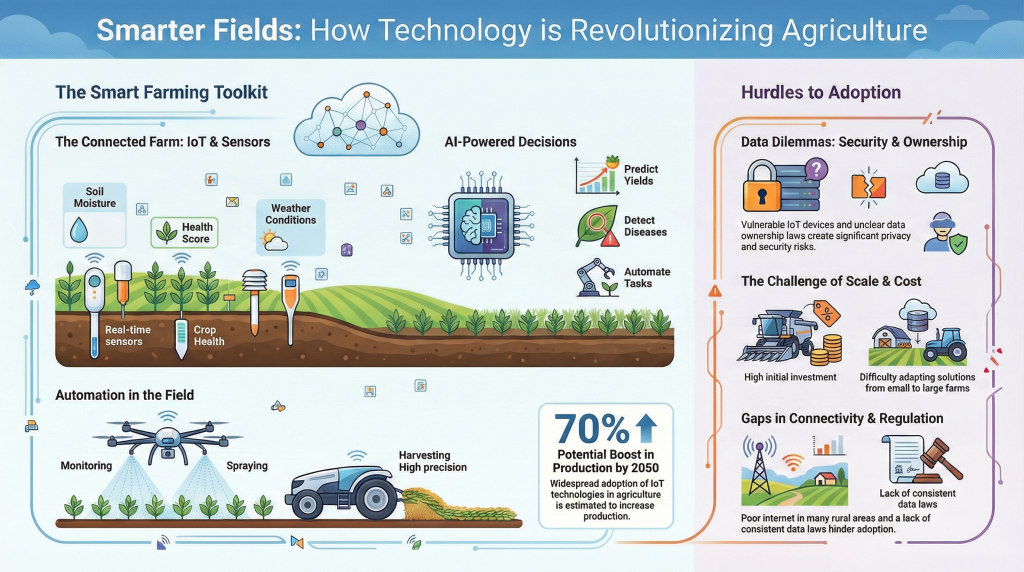
The agricultural landscape is undergoing a transformation of unprecedented magnitude. With the global population projected to reach 9.7 billion by 2050, humanity faces an immense challenge: how do we produce enough food to feed the world while simultaneously protecting our finite environmental resources? The answer lies in Smart Farming—also known as Agriculture 4.0—a revolutionary paradigm that integrates Artificial Intelligence (AI), the Internet of Things (IoT), Big Data analytics, Robotics, and Unmanned Aerial Vehicles (UAVs) into the very foundation of food production.
This comprehensive analysis explores the groundbreaking insights from recent peer-reviewed research published in the International Journal of Research in Agronomy. The work by Thakur and Chhabra from Lovely Professional University represents one of the most thorough examinations of smart farming technologies, their applications, challenges, and future potential. This blog post expands upon their findings to provide actionable insights for two critical stakeholder groups: academic researchers seeking to advance the field, and importers/exporters working to revolutionize global food supply chains.
Over the following sections, we will explore not only the technologies themselves but also their strategic implications, implementation challenges, and the transformative potential they hold for creating a sustainable, profitable, and efficient agricultural future.
1. The Technological Pillars of Smart Farming: Understanding the Foundation
Smart farming represents a fundamental departure from traditional agricultural practices. Where conventional farming relies heavily on experience, intuition, and broad-scale interventions, Agriculture 4.0 leverages real-time data, predictive analytics, and precision-targeted actions. The system is inherently context-aware and situation-driven, meaning that every decision—from when to water crops to which pesticides to apply—is informed by current, accurate data gathered from the field itself.
This approach rests on several interconnected technological pillars, each playing a critical role in creating an intelligent, responsive farming ecosystem.
1.1 The Power and Precision of Artificial Intelligence
Artificial Intelligence serves as the cognitive engine of smart farming. AI systems can process enormous volumes of data from disparate sources—weather stations, soil sensors, satellite imagery, historical yield records—and extract actionable patterns that would be impossible for human analysts to discern manually. The result is a farming operation that can anticipate challenges before they occur and optimize resource allocation with surgical precision.
Artificial Neural Networks (ANNs)
ANNs represent one of the foundational AI architectures used in agricultural applications. These networks mimic the structure of biological neurons, creating layers of interconnected nodes that can learn complex patterns from training data. In smart farming, ANNs are particularly valuable for crop analysis tasks that require the integration of multiple variables simultaneously.
For example, an ANN might analyze weather conditions (temperature, humidity, precipitation patterns), soil characteristics (pH, nutrient levels, moisture content), and historical crop performance data to predict optimal planting dates or identify crops at risk of disease. The network’s ability to process non-linear relationships makes it exceptionally well-suited for the chaotic, interdependent systems that characterize agricultural environments.
Convolutional Neural Networks (CNNs)
CNNs excel at processing visual and spatial data, making them indispensable for image-based agricultural tasks. These networks use specialized layers that can detect features like edges, textures, and patterns in images, enabling them to identify plant diseases, assess crop health, or distinguish between different plant species from aerial photographs.
In the context of meteorological analysis, CNNs process satellite imagery and radar data to identify weather patterns that might affect crop growth. The network can perform operations like filtration (removing noise from sensor data) and standardization (normalizing data from different sources), ensuring that the information fed into decision-making systems is accurate and consistent. CNNs have proven particularly effective at early detection of pest infestations and nutrient deficiencies, often identifying problems weeks before they become visible to the human eye.
Recurrent Neural Networks (RNNs) and Long Short-Term Memory (LSTM)
Unlike traditional neural networks that process each data point independently, RNNs and their more sophisticated variant, LSTM networks, maintain a form of memory that allows them to consider sequences of data over time. This temporal awareness makes them ideal for forecasting tasks where historical context is crucial.
Weather forecasting represents one of the most valuable applications of LSTM networks in agriculture. By analyzing years of historical weather data—temperature fluctuations, rainfall patterns, wind speeds, humidity levels—these networks can predict future conditions with remarkable accuracy. This capability extends beyond simple weather prediction to yield forecasting, where LSTM models incorporate historical yield data, soil health metrics, climate trends, and agronomic practices to project future harvest outcomes.
For example, an LSTM network might analyze five years of data showing how a particular wheat variety performed under varying rainfall conditions, soil nutrient levels, and temperature ranges. Armed with this historical knowledge and current season predictions, the network can advise farmers on expected yields and recommend interventions to maximize productivity.
Support Vector Machines (SVMs)
SVMs offer a different approach to pattern recognition, excelling at classification tasks where data needs to be sorted into distinct categories. In smart farming, SVMs can analyze digital photographs of soil samples to forecast moisture levels and classify samples by pH level and nutritional content. This technology enables rapid, non-destructive soil analysis—farmers can take a photograph in the field and receive immediate feedback on soil conditions, eliminating the delays associated with laboratory testing.
1.2 The Internet of Things: Creating the Nervous System of the Farm
If AI serves as the brain of smart farming, the Internet of Things functions as its nervous system—a vast network of sensors and connected devices that continuously gather data from every corner of the agricultural operation. IoT technology enables anytime, anywhere accessibility to farm data, breaking down the traditional barriers of time and space that have historically limited agricultural management.
Soil Moisture Sensors
Soil moisture sensors represent one of the most critical IoT components in precision agriculture. These devices use electrical resistivity measurements to indirectly calculate the volumetric water content in soil. As water conducts electricity more readily than dry soil, changes in electrical resistance provide an accurate proxy for moisture levels.
Modern soil moisture sensors can be deployed in dense networks across fields, creating detailed moisture maps that reveal variability invisible to the naked eye. This granular data enables precision irrigation—water is applied only where and when it is needed, reducing waste, preventing over-watering that can lead to root diseases, and conserving precious water resources. Studies have shown that precision irrigation guided by IoT sensors can reduce water consumption by 30-50% while maintaining or even improving crop yields.
Temperature and Humidity Sensors
Environmental conditions play a crucial role in crop development, pest activity, and disease proliferation. Temperature and humidity sensors provide simultaneous, real-time data on these critical variables, enabling farmers to respond proactively to changing conditions.
For instance, specific combinations of temperature and humidity create ideal conditions for fungal diseases like powdery mildew or late blight. By monitoring these variables continuously, farmers can receive automated alerts when conditions reach critical thresholds, allowing them to apply preventive treatments before disease outbreaks occur. This proactive approach reduces crop losses, minimizes pesticide use, and lowers production costs.
pH and Nutrient Sensors
Soil chemistry determines what crops can grow successfully and how much fertilizer is required to achieve optimal yields. pH sensors measure soil acidity or alkalinity, while specialized nutrient sensors track the levels of essential elements like Nitrogen (N), Phosphorus (P), and Potassium (K)—collectively known as NPK—as well as micronutrients like iron, manganese, and zinc.
Real-time nutrient monitoring transforms fertilizer application from a generalized practice into a precision science. Instead of applying uniform amounts of fertilizer across entire fields, farmers can use variable-rate technology to deliver exactly the right amount of nutrients to each zone based on current soil conditions. This approach not only reduces fertilizer costs—which can represent a significant portion of operating expenses—but also minimizes environmental damage from nutrient runoff, which contributes to water pollution and ecosystem degradation.
1.3 Unmanned Aerial Vehicles: Eyes and Hands from Above
Agricultural drones have earned their classification as green-tech instruments through their ability to dramatically improve resource efficiency while reducing environmental impact. These UAVs, equipped with GPS navigation systems, high-resolution cameras, and micro-electromechanical systems (MEMS) sensors, provide farmers with capabilities that were unimaginable just a decade ago.
3D Mapping and Land Management
UAVs can rapidly survey large agricultural areas, creating detailed 2D and 3D maps that reveal topographical features, drainage patterns, and areas of crop stress. These maps enable practical land-use planning, helping farmers optimize field layouts, design efficient irrigation systems, and identify problem areas that require special attention.
The 3D mapping capability proves particularly valuable for understanding water flow across fields. By revealing subtle elevation changes, these maps help farmers predict where water will accumulate during heavy rains or where irrigation might be insufficient. This information guides the placement of drainage systems, the design of terracing on sloped land, and the optimization of irrigation infrastructure.
Precision Spraying
One of the most transformative applications of UAV technology is precision spraying of pesticides, herbicides, and fertilizers. Traditional spraying methods apply chemicals uniformly across fields, resulting in overuse in some areas and waste of expensive inputs. Worse, overspray contributes to environmental contamination and the development of pesticide-resistant pest populations.
Drone-based precision spraying solves these problems by applying chemicals only where they are needed. Using data from multi-spectral imaging and AI analysis, drones can identify specific plants or areas requiring treatment and deliver precisely calibrated doses. This targeted approach can reduce chemical use by 30-90% depending on the application, dramatically lowering costs while minimizing environmental impact. Additionally, drone spraying significantly reduces labor requirements and eliminates the safety risks associated with manual pesticide application.
Weed Detection and Management
Multi-spectral sensors on UAVs can distinguish between crop plants and invasive weeds by analyzing differences in their spectral signatures—the unique patterns of light they reflect across different wavelengths. This capability enables automated weed detection across vast areas, identifying problem zones that require intervention.
The implications extend beyond simple identification. Once weed locations are mapped, farmers can deploy targeted treatments—either through drone-based spot spraying or ground-based precision equipment—rather than blanket herbicide applications. Some advanced systems even integrate mechanical weed removal robots that can physically extract invasive plants without chemicals, offering an organic solution to weed management.
1.4 Cloud Computing and Big Data Infrastructure
The sensors, drones, and AI systems described above generate enormous volumes of data—far too much for individual farms to store and process using local computing resources. Cloud computing provides the solution, offering on-demand access to vast processing power and storage capacity without requiring substantial capital investment in physical infrastructure.
Cloud Service Models
Cloud computing in agriculture typically operates through three service models:
• Software as a Service (SaaS): Farmers access agricultural management applications through web browsers without installing software locally. These platforms handle everything from crop planning to financial management, with all data automatically backed up and synchronized across devices.
• Platform as a Service (PaaS): Developers build custom agricultural applications using cloud-based development platforms, enabling specialized solutions tailored to specific crops, regions, or farming practices.
• Infrastructure as a Service (IaaS): Organizations rent computing resources (servers, storage, networking) on demand, scaling capacity up or down based on seasonal needs—critical for agricultural operations that face huge data processing spikes during planting and harvest seasons.
Big Data Analytics
Cloud platforms enable sophisticated big data analytics that can identify patterns across multiple farms, regions, or even countries. By aggregating and analyzing data from thousands of farms, these systems can identify best practices, predict regional pest outbreaks, forecast commodity prices, and provide benchmarking data that helps individual farmers understand how their operations compare to peers. This collective intelligence creates a feedback loop where every farm contributes to and benefits from shared knowledge.
2. Strategic Benefits for Key Stakeholders: Maximizing Research and Trade Impact
The comprehensive research by Thakur and Chhabra provides more than just a technical overview—it offers a strategic roadmap for two distinct but interconnected stakeholder groups. Understanding how different audiences can leverage this research is crucial for accelerating the adoption and evolution of smart farming technologies.
2.1 Strategic Applications for Academic Researchers and Innovators
For scientists, engineers, and academics working to advance agricultural technology, this research serves as both a foundation and a launching pad. The paper’s value extends far beyond its comprehensive technology review—it provides a structured framework for identifying opportunities for innovation and addressing critical gaps in current smart farming systems.
Identifying High-Impact Research Gaps
One of the paper’s most valuable contributions is its systematic identification of research needs and technological gaps. These gaps represent opportunities for breakthrough innovations that could significantly advance the field. Key areas highlighted include:
• Data Security and Privacy: As farms become increasingly digitized, protecting sensitive agricultural data from cyber-attacks becomes paramount. Current IoT devices often lack robust security features, making them vulnerable to intrusion. Research is needed to develop lightweight encryption protocols suitable for resource-constrained agricultural sensors, secure blockchain implementations for farm data, and intrusion detection systems tailored to agricultural networks.
• Livestock Welfare and Sensor Psychology: While wearable sensors for livestock health monitoring show tremendous promise, limited research exists on the psychological and behavioral impacts of these devices on animals. Do sensors cause stress? Do animals adapt to wearing them? How might sensor presence affect natural behaviors? These questions represent a largely unexplored intersection of veterinary science, animal psychology, and technology design.
• Edge Computing for Real-Time Decision Making: Current cloud-based systems introduce latency that can be problematic for time-critical decisions. Research into edge computing—processing data locally on farm equipment rather than in distant data centers—could enable instantaneous responses to changing conditions, crucial for applications like autonomous tractors navigating around obstacles or drones adjusting spray patterns in real-time based on wind conditions.
• Energy Efficiency and Sustainability: Operating dense networks of IoT sensors and energy-intensive AI computations raises questions about the carbon footprint of smart farming. Research is needed to develop energy-efficient sensors, renewable energy integration strategies, and algorithms optimized to minimize computational demands without sacrificing accuracy.
Privacy-Preserving Big Data Architectures
The paper presents a detailed big data lifecycle strategy that researchers can use as a foundation for developing better privacy assurance procedures. The lifecycle encompasses data collection, transmission, storage, analysis, and dissemination—each stage presenting unique privacy challenges.
Researchers can extend this framework by developing:
• Federated Learning Systems: These allow AI models to learn from data distributed across multiple farms without ever centralizing the sensitive data itself. Each farm’s data remains local while the model benefits from collective learning.
• Differential Privacy Mechanisms: Mathematical techniques that add carefully calibrated noise to data, enabling useful analysis while protecting individual farm operations from being reverse-engineered from aggregate statistics.
• Secure Multi-Party Computation: Cryptographic protocols that allow multiple stakeholders to jointly compute functions over their combined data without revealing their individual inputs.
Technology Taxonomy and Structured Innovation
The paper’s systematic categorization of technologies—from AI models (ANN, CNN, RNN, LSTM, SVM) to cloud service models (SaaS, PaaS, IaaS) to sensor types—provides researchers with a structured taxonomy that facilitates systematic experimentation and comparison.
This taxonomy enables researchers to identify which combinations of technologies have been thoroughly explored and which remain understudied. For example, while CNNs have been extensively applied to disease detection in row crops like corn and soybeans, their use in orchard crops or greenhouse environments remains relatively unexplored. Similarly, while soil moisture sensors are widespread, the integration of soil moisture data with economic models that optimize irrigation based on water costs and crop prices represents an underdeveloped research area.
2.2 Strategic Insights for Importers, Exporters, and Supply Chain Professionals
For those involved in global agricultural trade, the smart farming revolution represents an opportunity to fundamentally transform supply chain operations. The integration of IoT, blockchain, and AI technologies can address longstanding challenges in food quality, traceability, waste reduction, and market efficiency.
End-to-End Supply Chain Traceability
Modern consumers increasingly demand transparency about the origins and handling of their food. Concerns about food safety, authenticity (such as organic certification), and ethical sourcing create both challenges and opportunities for agricultural supply chains.
By integrating blockchain technology with IoT sensors, exporters can create immutable records that trace produce from farm to consumer. Each stage of the supply chain—harvest, processing, storage, transportation, retail—can be documented with tamper-proof digital signatures. Consumers can scan QR codes to view the complete history of their food: which farm grew it, when it was harvested, how it was transported, what temperatures it experienced during shipping, and what certifications it holds.
This transparency builds what the research describes as confidence and clarity—consumers can verify that organic products are genuinely organic, that sustainability claims are substantiated, and that food safety standards have been maintained throughout the supply chain. For exporters, this transparency becomes a competitive advantage, enabling premium pricing for products with verified quality and provenance.
Post-Harvest Quality Control and Shelf-Life Extension
Significant food losses occur not in the field but during storage and transportation. Temperature fluctuations, humidity variations, and ethylene gas buildup can dramatically accelerate spoilage, turning profitable shipments into losses.
IoT sensors deployed in storage facilities and transportation containers provide real-time monitoring of environmental conditions. If temperature rises above optimal ranges—perhaps due to refrigeration failure—automated alerts notify operators immediately, enabling corrective action before produce is damaged. Similarly, humidity sensors can trigger ventilation systems to prevent condensation that promotes mold growth.
For importers, this capability offers several advantages:
• Quality Assurance: Real-time data provides confidence that products have been maintained under optimal conditions throughout their journey, reducing the risk of receiving degraded goods.
• Extended Shelf Life: Optimal storage conditions can significantly extend product viability, providing more flexibility in distribution and reducing losses from expired inventory.
• Liability Documentation: If products do arrive damaged, sensor data provides clear evidence of when and where conditions fell outside specifications, facilitating insurance claims and resolving disputes about responsibility.
• Predictive Inventory Management: By tracking the actual conditions experienced by different shipments, importers can prioritize distribution—products that experienced suboptimal conditions can be sold first before quality degrades, while those maintained under ideal conditions can be held longer.
Market-Driven Production and Waste Reduction
Traditional agricultural markets suffer from significant information asymmetry. Farmers often make planting decisions based on limited information about future demand, leading to cycles of overproduction followed by scarcity. When too many farmers plant the same crop in response to high prices, oversupply causes prices to crash, leaving farmers with products they cannot sell profitably. The reverse scenario—undersupply—leaves consumers facing high prices and importers struggling to source adequate quantities.
Smart farming platforms can integrate real-time market data, demand forecasts, and global production statistics, providing farmers with sophisticated decision-support tools. Exporters can use these systems to actively guide production, advising contracted farmers about which crops to plant, optimal planting dates, and expected market windows.
This market-driven approach yields multiple benefits:
• Reduced Overproduction: By coordinating planting decisions across their supplier network, exporters can avoid saturating markets and maintain more stable pricing.
• Better Crop Diversity: Real-time market data can encourage farmers to diversify their crops, reducing risk and improving soil health through crop rotation.
• Waste Minimization: Matching production more closely to demand reduces the enormous waste that occurs when perishable goods cannot find buyers.
• Price Stability: Reducing boom-bust cycles creates more predictable pricing, benefiting farmers, traders, and consumers alike.
Intelligent Logistics and Route Optimization
Transportation represents a major cost component in agricultural supply chains, particularly for perishable goods requiring refrigerated shipping. Smart farming technologies extend beyond the farm gate to encompass intelligent logistics solutions that maximize efficiency throughout the distribution network.
AI-powered route optimization systems consider multiple variables simultaneously: transportation costs, fuel prices, weather conditions, traffic patterns, port congestion, and delivery deadlines. These systems can dynamically reroute shipments to avoid delays, consolidate partial loads to reduce costs, and prioritize high-value or time-sensitive products for expedited delivery.
For high-value crops like fresh berries, exotic fruits, or premium vegetables, these optimizations can mean the difference between products reaching markets in peak condition commanding premium prices or arriving degraded and unsaleable. The research emphasizes that these intelligent logistics solutions ensure that high-value crops reach the marketplace in peak condition, maximizing returns for everyone in the supply chain.
3. Comprehensive Application Areas: From Field to Fork
Smart farming technologies find applications across the entire agricultural value chain, from initial crop planning through post-harvest handling and distribution. Understanding these diverse applications reveals the comprehensive transformation that Agriculture 4.0 represents.
3.1 Precision Crop Production
Crop production represents the most mature application area for smart farming technologies, with implementations ranging from large-scale commodity agriculture to specialized horticulture.
Variable Rate Technology (VRT)
VRT enables farmers to vary the application rates of seeds, fertilizers, pesticides, and water across their fields based on localized conditions. Rather than treating entire fields uniformly, VRT systems use prescription maps generated from sensor data, soil analyses, and yield histories to deliver precisely calibrated inputs to each zone.
For example, areas with sandy soil that drains quickly might receive more frequent, smaller irrigation applications, while clay-rich zones with better water retention receive less frequent, larger applications. Similarly, sections of a field with historically low yields might receive additional fertilizer or different seed varieties better suited to those conditions.
Automated Pest and Disease Management
Integration of image recognition, IoT sensors, and AI creates automated systems for early detection and targeted treatment of pests and diseases. Field cameras and drones continuously survey crops, with CNN-based systems analyzing images to identify signs of infestation or infection—often before symptoms become visible to human observers.
When problems are detected, the system can automatically trigger targeted responses: deploying drones for spot treatment, releasing beneficial insects to control pest populations, or alerting farmers to apply specific treatments. This precision dramatically reduces pesticide use while improving effectiveness, as interventions occur early when small pest populations are easier to control.
Autonomous Field Operations
Robotic systems are increasingly capable of performing traditional field tasks with minimal human oversight. Autonomous tractors can plow, plant, and harvest using GPS guidance with centimeter-level accuracy. Weeding robots can distinguish crops from weeds and remove invasive plants mechanically without herbicides. Harvesting robots equipped with computer vision can assess fruit ripeness and pick only produce at optimal maturity.
These automated systems address labor shortages that plague many agricultural regions while ensuring consistency and precision impossible with manual operations. They can work around the clock, maximizing efficiency during critical windows like planting or harvest. Moreover, by reducing human error and optimizing operations, they improve yields and product quality.
3.2 Advanced Livestock Management
While crop applications have received the most attention, smart farming technologies are equally transformative for livestock operations, offering unprecedented capabilities for monitoring animal health and welfare.
Wearable Sensors for Individual Animal Monitoring
Modern wearable sensors can track numerous physiological parameters and behavioral patterns for individual animals within large herds:
• Activity Levels: Accelerometers detect changes in movement patterns that might indicate illness, injury, or reproductive status. For example, decreased activity combined with increased lying time often signals illness before other symptoms appear.
• Body Temperature: Continuous temperature monitoring enables early detection of fever, a common indicator of infection or disease.
• Rumination Patterns: For ruminant animals like cattle, changes in rumination activity can indicate digestive problems or metabolic disorders.
• Location Tracking: GPS-enabled sensors allow ranchers to monitor animal locations on large pastures, ensuring they have access to water and detecting if animals have become separated from the herd.
• Reproductive Indicators: Sensors can detect behavioral and physiological changes associated with estrus, optimizing breeding timing and improving conception rates.
However, as the research notes, there exists a critical gap in understanding the psychological impact of these wearable sensors on animals. Do devices cause stress or discomfort? How do animals adapt over time? These questions require interdisciplinary research combining veterinary science, animal behavior, and sensor design to ensure that the benefits of monitoring do not come at the cost of animal welfare.
Automated Feeding Systems
Smart feeding systems can adjust rations for individual animals based on their specific nutritional needs, determined by factors like age, weight, production status (pregnant, lactating), and health condition. This precision nutrition improves animal health and productivity while reducing feed waste—a significant cost factor in livestock operations.
Disease Outbreak Prediction and Prevention
By analyzing collective data from entire herds, AI systems can identify patterns that precede disease outbreaks. If multiple animals show subtle changes in behavior or physiology consistent with the early stages of a contagious disease, the system can alert operators to implement biosecurity measures, isolate potentially affected animals, and prevent the spread of illness through the herd.
This capability proves particularly valuable for managing diseases like bovine respiratory disease in cattle or avian influenza in poultry—conditions that can devastate entire operations if not caught early.
3.3 Post-Harvest Management and Traceability
The agricultural value chain does not end at harvest—in fact, post-harvest losses represent a significant challenge, particularly in developing regions where inadequate storage and transportation infrastructure results in up to 40% of production being lost before reaching consumers.
Blockchain-Enabled Traceability
Blockchain technology creates tamper-proof records of product movement through the supply chain. Each transaction or transfer of custody is recorded as a block in the chain, cryptographically linked to previous blocks in a way that makes alterations essentially impossible to conceal.
This capability has profound implications for food safety. When contamination is discovered, blockchain-enabled traceability allows rapid identification of affected batches and precise targeting of recalls—minimizing waste while protecting public health. Traditional recall systems often require pulling entire production runs or even all products from a facility; blockchain enables surgical precision, recalling only specific lots confirmed to be contaminated.
Smart Storage Facilities
IoT-enabled storage facilities maintain optimal conditions through automated environmental control. Sensors continuously monitor temperature, humidity, carbon dioxide levels, and ethylene concentrations—each affecting product quality and shelf life differently.
AI systems analyze this data in real-time, adjusting ventilation, refrigeration, and humidity control to maintain ideal conditions for the specific products being stored. For example, apples benefit from controlled atmosphere storage with elevated CO2 and reduced oxygen, while bananas require ethylene management to control ripening. Smart facilities can manage multiple product types simultaneously, optimizing conditions for each while minimizing energy consumption.
Quality Assessment and Sorting
Computer vision systems can assess product quality with greater consistency and speed than human inspectors. These systems evaluate size, color, shape, and surface defects, automatically sorting products into quality grades. Advanced systems can even use spectral imaging to assess internal quality characteristics like sugar content in fruits or moisture levels in grains—parameters invisible to the naked eye.
This automated grading improves efficiency, ensures consistency, and enables producers to command premium prices for top-quality products while appropriately pricing lower grades for processing or alternative markets.
Related Article: Agricultural Intelligence: The Ultimate Guide to AI-Driven Performance and the Future of Smart Farming
4. Critical Success Factors: Understanding Implementation Prerequisites
The effectiveness of smart farming technologies is not uniform across all contexts. Multiple parameters influence whether implementations succeed or fail, and understanding these factors is essential for strategic planning and realistic expectation-setting.
4.1 Climate and Environmental Variability
Climate represents one of the most significant variables affecting agricultural outcomes, and smart farming systems must integrate sophisticated weather forecasting and climate modeling to provide value.
In regions with stable, predictable weather patterns, basic systems can deliver excellent results. However, areas facing extreme weather events—heat waves, droughts, floods, hurricanes—require more robust implementations incorporating advanced AI models capable of predicting and adapting to these challenges.
For example, LSTM networks analyzing historical weather data can predict the likelihood of frost events, allowing farmers to take protective measures like wind machines or sprinkler irrigation to prevent crop damage. Similarly, systems monitoring soil moisture and weather forecasts can optimize irrigation schedules to prepare fields for predicted rainfall, reducing waterlogging risks while maximizing water capture.
Climate change is intensifying weather variability, making these predictive capabilities increasingly valuable. Regions that historically experienced stable conditions now face greater uncertainty, creating both challenges and opportunities for smart farming adoption.
4.2 Soil Characteristics and Management
Soil is not a uniform medium—its properties vary dramatically even within individual fields. Composition (sandy, loamy, clay-rich), pH levels, organic matter content, nutrient availability, and microbial communities all influence what crops can be grown successfully and what management practices are required.
Smart farming systems excel at managing this variability through detailed soil mapping and analysis. By understanding the specific characteristics of different zones, farmers can make informed decisions about:
• Crop Selection: Matching crop varieties to soil types maximizes yields and reduces input requirements. For instance, sandy soils suit crops with low water requirements, while heavy clays better support crops tolerant of wetter conditions.
• Nutrient Management: Different soil types retain and release nutrients differently. Sandy soils have low nutrient-holding capacity, requiring frequent small applications, while clay soils hold nutrients more effectively but may lock up certain elements making them unavailable to plants.
• Irrigation Strategies: Soil texture dramatically affects water infiltration and retention. Smart systems adjust irrigation based not just on crop needs but on soil characteristics—delivering water slowly to heavy clays to prevent runoff, or more frequently to sandy soils that drain quickly.
• Soil Health Improvement: Continuous monitoring enables adaptive management to improve soil health over time. Systems can track changes in organic matter, suggest appropriate cover crops or amendments, and measure the effectiveness of soil improvement efforts.
4.3 Crop Type and Value Considerations
Different crops present vastly different economic cases for smart farming adoption. High-value crops like fruits, vegetables, and specialty products can justify substantial investment in monitoring and precision management, as the returns from improved quality and reduced losses significantly exceed system costs.
For high-value crops:
• Intensive monitoring of nutrients and pests becomes economically viable, as even small improvements in quality or reductions in loss translate to significant revenue gains.
• Precision irrigation systems that maintain optimal moisture levels prevent stress that would reduce marketability or shelf life.
• Advanced disease detection and management prevent losses that could destroy an entire high-value crop before harvest.
Conversely, commodity crops like wheat, corn, or soybeans operate on thin profit margins, requiring more cost-effective implementations. For these crops, technologies must demonstrate clear return on investment through increased yields, reduced input costs, or decreased labor requirements.
This economic reality means that smart farming adoption may occur unevenly across crop types and farm scales, with high-value specialty agriculture leading adoption while commodity production follows as costs decline and benefits become more clearly documented.
4.4 Automation, Machinery, and Labor Dynamics
The level of mechanization and automation achievable depends on numerous factors: crop characteristics, field conditions, capital availability, and labor market dynamics. However, where automation is feasible, it delivers substantial benefits.
Autonomous Tractors and Implements
GPS-guided autonomous tractors can perform field operations with centimeter-level precision, ensuring perfect row spacing during planting, optimal depth control, and minimal overlap or gaps during tillage, spraying, or fertilizer application. This precision reduces waste, improves crop establishment, and eliminates human error.
Moreover, autonomous equipment can operate around the clock, maximizing efficiency during critical windows. When weather forecasts show a narrow planting window before rain, autonomous systems can work continuously to complete operations on schedule.
Robotic Weeding and Harvesting
Specialized robots can perform labor-intensive tasks that have historically been bottlenecks in agricultural production. Weeding robots equipped with computer vision can distinguish crops from weeds and remove invasive plants mechanically, eliminating herbicide costs and residues while providing organic farming operations with viable weed management.
Harvesting robots address labor shortages particularly acute in specialty crops requiring hand-picking. These machines can assess ripeness, select only mature produce, and harvest without damage—all while working continuously at consistent speeds regardless of weather or time of day.
Labor Economics and Social Considerations
Automation raises important questions about labor displacement and rural employment. While machines reduce the need for manual labor in field operations, they create demand for different skills—technicians to maintain equipment, data analysts to interpret sensor outputs, and agronomists to translate insights into management decisions.
The transition period presents challenges requiring thoughtful policy responses: retraining programs for displaced workers, support for small operations that cannot afford large-scale automation, and attention to how automation affects rural communities and economies. These social dimensions of smart farming adoption deserve careful consideration alongside the technical and economic factors.
5. Confronting Implementation Challenges: Barriers to Widespread Adoption
Despite the tremendous potential of smart farming technologies, significant challenges impede widespread adoption. Understanding these barriers is essential for developing effective strategies to overcome them and accelerate the transformation of global agriculture.
5.1 Economic Barriers: Capital Requirements and ROI Uncertainty
The initial investment required for smart farming implementation represents a substantial barrier, particularly for small and medium-sized operations. Comprehensive systems require:
• Hardware Costs: IoT sensors, base stations, networking equipment, autonomous machinery, drones, and computers all require significant capital investment. A basic precision agriculture setup for a medium-sized farm might cost $50,000-$200,000 or more depending on farm size and technology sophistication.
• Software and Services: Subscription fees for data analysis platforms, cloud storage, AI model access, and technical support create ongoing expenses that must be factored into economic calculations.
• Training and Expertise: Operating smart farming systems requires new skills. Farmers need training, which costs time and money, and may need to hire specialists for complex troubleshooting or advanced analysis.
• Maintenance and Upgrades: Electronic equipment requires regular maintenance, calibration, and eventual replacement. Software platforms need updates, and sensors have finite lifespans requiring periodic renewal.
Return on investment varies significantly depending on crop type, farm size, management practices, and local conditions. While some operations document impressive improvements—30% reductions in water use, 20% increases in yields, 40% decreases in pesticide applications—others see more modest gains. This uncertainty makes securing financing challenging, particularly in regions where agricultural lending is already constrained.
Addressing these economic barriers requires creative financing mechanisms: government subsidies for technology adoption, cooperative purchasing arrangements that allow smaller operations to share costs, and leasing programs that reduce upfront capital requirements. Additionally, clear, documented case studies showing ROI in various contexts can reduce uncertainty and encourage investment.
5.2 The Digital Divide: Infrastructure and Access Disparities
Smart farming systems depend on robust digital infrastructure—high-speed internet connectivity, cellular coverage, and reliable power supplies. Unfortunately, many agricultural regions, particularly in developing countries and remote areas of developed nations, lack this infrastructure.
Connectivity Challenges
Real-time data systems require consistent connectivity to transmit sensor readings to cloud platforms, receive AI-generated recommendations, and enable remote monitoring. However, many rural areas suffer from limited broadband access, unreliable cellular coverage, or prohibitive connectivity costs.
The rollout of 5G networks promises improvements, offering higher bandwidth, lower latency, and greater capacity to support dense networks of IoT devices. However, 5G deployment tends to prioritize urban areas, potentially widening the gap between connected and disconnected agricultural regions.
Satellite-based internet services like Starlink offer potential solutions for remote areas, but costs remain high and service quality varies. Additionally, some smart farming applications require ultra-low latency for real-time decision-making—autonomous machinery navigating fields, for example—which satellite connections may not adequately support.
Power Availability
IoT sensors, base stations, and computing equipment require reliable power. In regions with unstable electrical grids or areas lacking grid connectivity, powering smart farming systems presents substantial challenges. Solar panels can provide solutions but add to system complexity and cost, particularly in regions with limited sunlight or where dust accumulation reduces panel efficiency.
Knowledge and Digital Literacy
Beyond physical infrastructure, the digital divide includes disparities in technical knowledge and digital literacy. Farmers must understand how to operate smart systems, interpret data outputs, and troubleshoot problems. In regions where education levels are lower or where older generations manage farms, this represents a significant adoption barrier.
Addressing the digital divide requires coordinated efforts: public investment in rural broadband infrastructure, policies encouraging telecommunications companies to serve agricultural areas, development of offline-capable or low-bandwidth systems for resource-constrained environments, and comprehensive training programs that meet farmers where they are in terms of existing technical knowledge.
5.3 Data Ownership, Privacy, and Security Concerns
As agriculture becomes increasingly data-driven, questions about who owns agricultural data, how it can be used, and how to protect it from misuse or theft have emerged as critical concerns.
The Data Ownership Controversy
When farmers use commercial smart farming platforms, their field data—yield histories, soil conditions, management practices—is typically uploaded to cloud servers operated by technology companies. Debates continue about whether this data belongs to the farmers who generated it or the companies providing the platforms.
This question has profound implications. Agricultural data holds significant value: seed companies might use aggregated data to guide breeding programs, commodity traders could leverage regional production data for market speculation, and competing farms might benefit from insights derived from a farmer’s data. Farmers reasonably question whether companies should profit from data they did not generate, while companies argue that significant investment in platform development justifies some data rights.
Clear legal frameworks establishing data ownership rights, requiring transparent disclosure of how agricultural data will be used, and giving farmers meaningful control over their information are essential for building trust in smart farming systems.
Security Vulnerabilities
The research emphasizes that many IoT devices are not designed with security as a priority, making them vulnerable to cyber-attacks. Agricultural systems present attractive targets for various threat actors:
• Ransomware Attacks: Criminals could lock farmers out of their systems during critical periods like planting or harvest, demanding payment for restored access.
• Data Theft: Competitors or market speculators might steal agricultural data for competitive or financial advantage.
• Sabotage: Nation-state actors could target agricultural infrastructure as part of broader economic warfare, manipulating irrigation systems to damage crops, tampering with autonomous equipment, or stealing intellectual property related to agricultural technology.
• Botnet Recruitment: Poorly secured IoT devices can be compromised and used as part of botnets launching distributed denial-of-service attacks against unrelated targets.
The potential economic impacts are substantial. Agriculture forms a critical component of national security—successful cyber-attacks disrupting food production could have cascading effects throughout economies. Protecting agricultural digital infrastructure requires attention at multiple levels: manufacturers must design secure devices, farmers need training in cybersecurity best practices, and governments should develop regulatory frameworks and support systems to enhance agricultural cyber-resilience.
5.4 Lack of Regulatory Frameworks and Standards
The rapid evolution of smart farming technologies has outpaced development of appropriate regulatory frameworks. This regulatory vacuum creates uncertainty and risk that slows adoption.
Technical Standards
Lack of interoperability standards forces farmers into vendor lock-in situations where equipment and software from different manufacturers cannot communicate effectively. A farmer might find that sensors from one company do not work with data platforms from another, or that upgrading to new equipment requires replacing entire systems rather than individual components.
Developing open standards for data formats, communication protocols, and API specifications would enable mix-and-match approaches where farmers can select best-in-class components from different vendors, fostering competition and innovation while reducing costs and risks.
Safety and Liability
Autonomous agricultural machinery operates in complex, unpredictable environments where traditional safety frameworks may not apply. Questions about liability when autonomous equipment causes accidents, damages crops, or injures people remain largely unresolved. Who bears responsibility when an AI system makes an incorrect recommendation that results in crop failure? What standards must autonomous equipment meet to operate safely around people, livestock, and other equipment?
Clear regulatory frameworks providing guidance on these questions would reduce uncertainty and encourage adoption by clarifying responsibilities and establishing reasonable safety expectations.
Privacy Regulations
Agricultural data privacy regulations remain underdeveloped in most jurisdictions. Comprehensive frameworks should address: who can access agricultural data, under what circumstances, with what protections, and with what recourse if data is misused. Regulations should balance farmers’ rights to privacy and control over their data against legitimate uses like agricultural research, food safety investigations, and environmental monitoring.
6. Looking Forward: The Path to Agriculture 5.0 and Beyond
While Agriculture 4.0 represents current cutting-edge practice, the trajectory of agricultural technology continues accelerating. Emerging technologies promise to address current limitations while opening new possibilities for sustainable, productive farming.
6.1 Next-Generation Technologies
Gene Editing and Precision Breeding
Integration of genomic data with field performance data enables unprecedented precision in crop breeding. CRISPR and other gene-editing technologies combined with AI analysis of phenotypic and environmental data can accelerate development of varieties optimized for specific conditions, resistant to emerging pests and diseases, or enhanced with nutritional improvements.
Nanotechnology
Nano-sensors could provide real-time monitoring at the cellular level, detecting stress, disease, or nutrient deficiencies before any visible symptoms appear. Nano-particles might deliver nutrients or pesticides with unprecedented precision, targeting specific cells or tissues while leaving surrounding areas untreated.
Advanced Robotics and Swarm Systems
Rather than single large machines, future farms might deploy swarms of small, specialized robots—each performing specific tasks and coordinating autonomously to manage entire operations. Such systems could provide extreme precision while offering redundancy and flexibility impossible with monolithic equipment.
Vertical and Controlled-Environment Agriculture
Smart farming technologies enable the economic viability of vertical farms and controlled-environment agriculture by optimizing every parameter—light, temperature, humidity, nutrients—for maximum efficiency. These systems could produce food near consumption centers, reducing transportation costs and emissions while enabling year-round production independent of weather or season.
6.2 Systemic Integration and Holistic Management
Agriculture 5.0 will likely be characterized by even tighter integration between technologies and more holistic management approaches. Rather than optimizing individual aspects of farming, next-generation systems will manage entire agricultural ecosystems, balancing productivity with environmental sustainability, economic viability with social responsibility.
This might include:
• Ecosystem Management: AI systems that optimize not just crop production but entire farm ecosystems, managing beneficial insects, soil microbiomes, and biodiversity to create resilient agricultural systems requiring minimal external inputs.
• Climate Adaptation: Systems that help farmers adapt to climate change by recommending crop switches, adjusting management practices, or implementing infrastructure changes based on long-term climate projections.
• Carbon Farming: Platforms that quantify and optimize carbon sequestration in agricultural soils, enabling farmers to participate in carbon markets while improving soil health.
• Circular Economy Integration: Smart systems that connect farms with other industries to create circular resource flows—agricultural waste becomes feedstock for bioenergy or biomanufacturing, while industrial byproducts provide agricultural nutrients.
6.3 Democratization and Accessibility
For smart farming to achieve its full potential, technologies must become accessible to all farmers regardless of farm size, location, or resources. This democratization requires:
• Cost Reductions: Continued decreases in sensor costs, computer processing power, and data storage expenses will make smart farming economically viable for smaller operations.
• Simplified Interfaces: User-friendly platforms that present recommendations clearly without requiring deep technical knowledge, making smart farming accessible to farmers with limited digital literacy.
• Shared Infrastructure: Cooperative or government-funded infrastructure that small farmers can access collectively, sharing costs while benefiting from advanced capabilities.
• Open-Source Alternatives: Development of open-source smart farming platforms that eliminate licensing fees and enable customization for local conditions.
• Appropriate Technology: Development of solutions suited to resource-constrained environments—low-power sensors, offline-capable systems, and equipment designed for challenging conditions found in developing regions.
Conclusion: Embracing the Smart Farming Revolution
The comprehensive research by Thakur and Chhabra provides an invaluable roadmap for understanding and implementing smart farming technologies. Their systematic analysis of AI systems, IoT sensors, UAVs, big data infrastructure, and cloud computing platforms reveals an agricultural sector undergoing profound transformation—from traditional, intuition-based practices to data-driven, precision-optimized systems.
For researchers, the paper identifies critical gaps where innovation is needed: data security protocols, privacy-preserving architectures, energy-efficient systems, and understanding of how technology affects livestock welfare. By providing structured taxonomies and highlighting research needs, the work creates a framework for systematic advancement of agricultural technology.
For importers and exporters, the revolution in supply chain transparency, quality control, and market intelligence offers unprecedented opportunities to reduce waste, command premium prices for traceable high-quality products, and optimize global food distribution networks. Integration of blockchain, IoT, and AI transforms supply chains from opaque, inefficient systems into transparent, responsive networks that serve producers, traders, and consumers alike.
Yet realizing smart farming’s full potential requires confronting substantial challenges. Economic barriers limit adoption among smaller operations. The digital divide threatens to create a two-tier agricultural system where well-connected farms thrive while isolated operations fall further behind. Data ownership controversies and security vulnerabilities raise legitimate concerns requiring thoughtful policy responses. Lack of regulatory frameworks creates uncertainty that slows investment and innovation.
Addressing these challenges demands coordinated action from multiple stakeholders:
• Governments must invest in rural digital infrastructure, develop appropriate regulatory frameworks, provide financial support for technology adoption, and fund research addressing critical gaps.
• Technology companies should prioritize interoperability, security, user-friendliness, and fair data practices while developing solutions accessible to diverse farm types and sizes.
• Agricultural organizations can facilitate cooperative adoption models, provide training and support, and advocate for farmers’ interests in technology development and policy-making.
• Research institutions should focus on demonstrating return on investment, developing appropriate technologies for diverse contexts, and addressing social dimensions of agricultural transformation.
• Farmers themselves must engage with these technologies thoughtfully, demanding transparency and fairness while embracing change necessary to meet future challenges.
The path forward is clear: smart farming represents not merely an option but a necessity for feeding 9.7 billion people sustainably. The technologies exist; the benefits are documented; the potential is enormous. What remains is collective commitment to overcoming barriers, ensuring equitable access, and managing the transition thoughtfully.
As we move toward Agriculture 5.0, the integration of smart technologies will deepen, systems will become more holistic, and capabilities will expand in ways we can barely imagine today. Nanotechnology, advanced robotics, gene editing, and artificial intelligence will converge to create agricultural systems that are simultaneously more productive and more sustainable, feeding humanity while healing the planet.
The revolution has begun. The question is not whether agriculture will transform, but whether that transformation will be equitable, sustainable, and beneficial for all. By grounding our efforts in solid research like that provided by Thakur and Chhabra, engaging thoughtfully with challenges, and working collectively toward solutions, we can ensure that the promise of smart farming becomes reality—creating an agricultural future that nourishes both people and planet for generations to come.
Related Article: The Future of Farming: How IoT is Revolutionizing Precision Agriculture
About the Source Research
This blog post is fundamentally based on the 2025 comprehensive review titled “A comprehensive review on smart farming” authored by Prashant Thakur and Dr. Vandna Chhabra from the Lovely Professional University, India. This research serves as a critical synthesis of modern “Agriculture 4.0” technologies, including AI, IoT, and UAVs, and was published in the International Journal of Research in Agronomy
Why This Research Matters for Our Readers:
• For Researchers: The study provides a structured taxonomy of AI models like ANN, CNN, and LSTM, specifically detailing their roles in weather and yield forecasting. It also identifies significant research gaps, such as the lack of regulatory frameworks and the psychological impact of wearable sensors on livestock
• For Importers & Exporters: The paper provides evidence-based insights into how Blockchain and IoT integration can solve traceability issues in the food supply chain, building market “confidence and clarity”. It further details how IoT storage sensors maintain post-harvest quality, ensuring products remain fresh for international trade
Formal Citation for Authenticity:
To verify the data or explore the technical depth of this study, please refer to the official publication:
Thakur, P., & Chhabra, V. (2025). A comprehensive review on smart farming. International Journal of Research in Agronomy, SP-8(3), 26-37.
Direct Access & DOI:
Researchers and professionals can access the full technical paper via the permanent Digital Object Identifier (DOI) link: https://www.doi.org/10.33545/2618060X.2025.v8.i3Sa.2610
